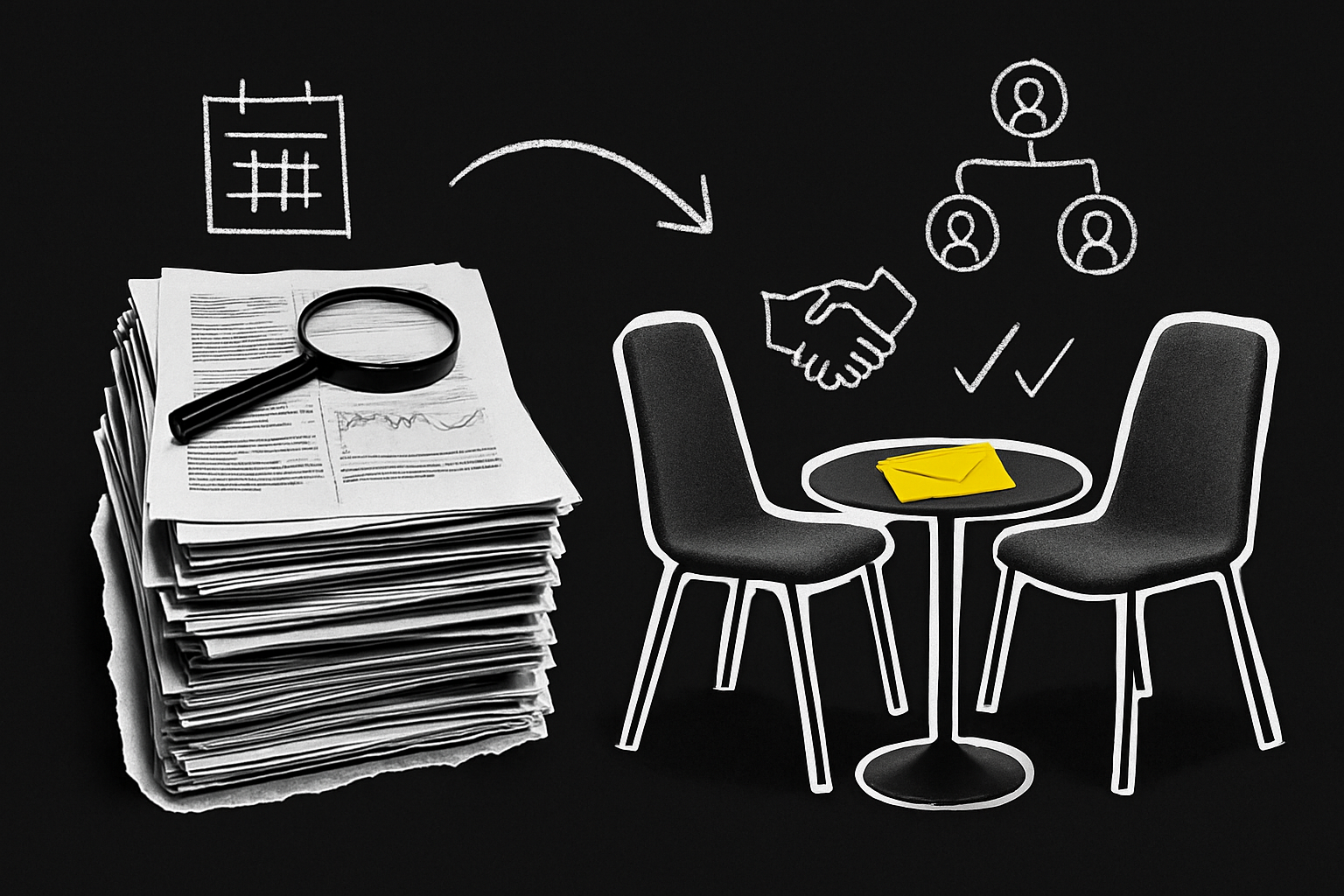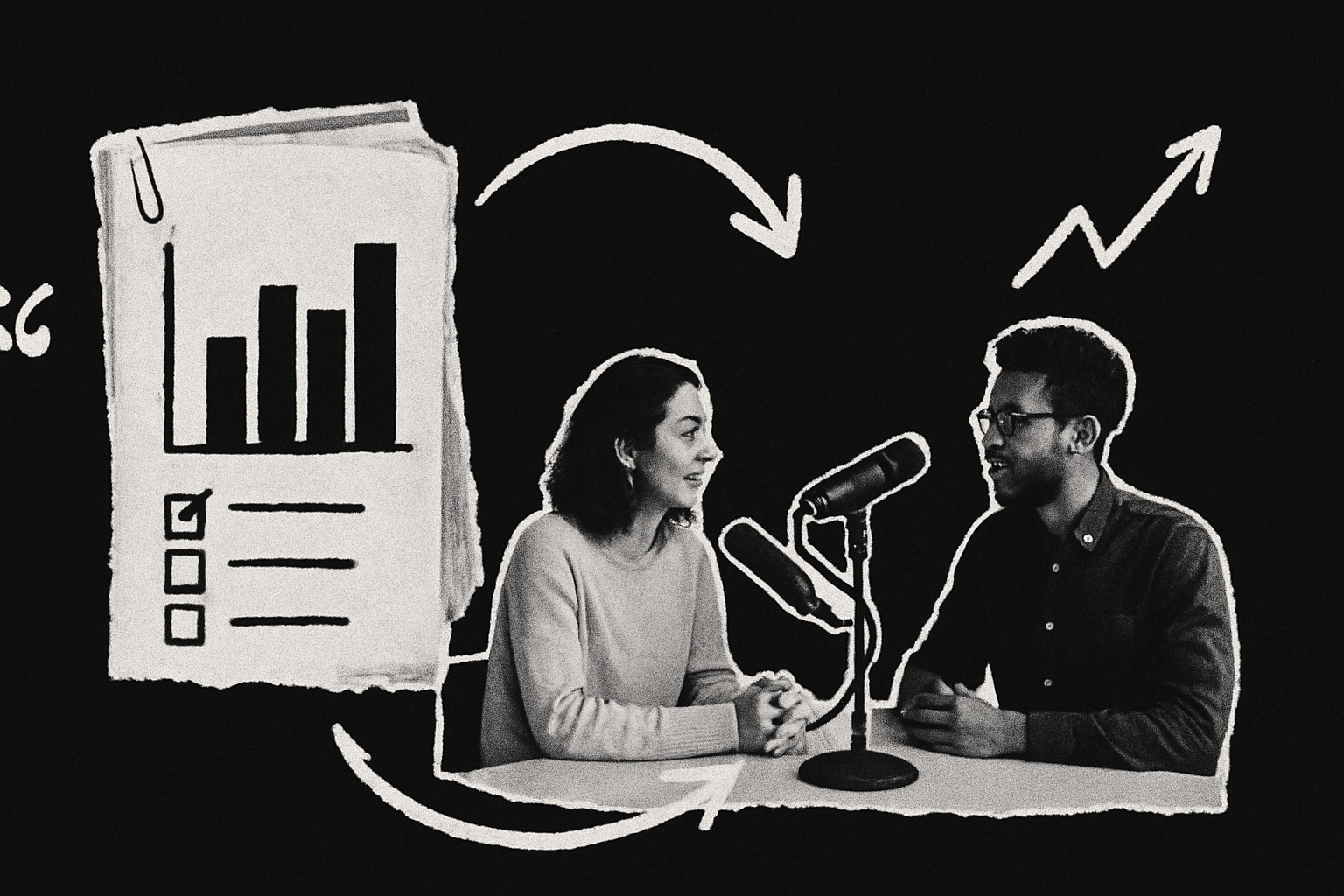
Produce in-house when your volume is high enough to keep a full-time producer busy, roughly 6-8 episodes a month across two or more shows, and when the show is the product rather than a marketing channel. Hire a B2B podcast agency when you are running one or two episodes a week, need to launch inside a month, and cannot afford production gaps.
That is the honest version. The longer answer matters because the decision is usually made on the wrong number: the agency invoice, compared against a salary, with everything else left out of the spreadsheet.
Is it cheaper to run a B2B podcast in-house?
Not in year one, and often not in year three either.
The published comparisons put first-year in-house production at roughly $68,000 to $161,000 once you include a fully loaded producer salary, equipment, and recruiting. Ongoing annual cost settles at around $65,000 to $130,000. Outsourced production across the same period runs roughly $30,000 to $90,000 a year, with full-service B2B podcast agencies charging somewhere between $2,500 and $15,000+ per month depending on tier.
Per-episode pricing tells a similar story from a different angle. Reported ranges span $500 to $15,000 per episode, with monthly retainers between $1,500 and $45,000. The bottom of that range buys recording and basic editing. The top buys studio recording, full post-production, and distribution.
The in-house number gets worse when you add what never makes it into the budget line. A podcast producer needs a manager. Somebody sets quarterly content strategy, approves episodes, chases sales for guest suggestions, and covers production when the producer is on holiday. That is 3-5 hours a week of a marketing leader’s time, costed at $12,000 to $30,000 a year in the same analysis. It is real money that shows up as a VP not doing something else.
Then there is turnover. Media producer tenure at a B2B company averages 18-24 months. Each departure means 2-4 months of recruiting, onboarding and ramp-up, and your show either goes quiet or gets visibly worse during it. If you have one producer, you have one resignation letter between you and a publishing gap.
None of this makes in-house wrong. It makes the comparison honest. A single salary looks cheaper than an agency retainer right up until you price the equipment, the management time, the recruiting fee, and the risk.
What does an agency do that an in-house team cannot?
Three things, and only one of them is editing.
The first is pattern recognition across many shows. An in-house producer learns your brand deeply and learns one show. An agency has watched dozens of B2B podcasts work and fail, which means it knows which formats hold a senior audience, which guest types actually convert to conversations, and which episode structures get abandoned at minute four. Your producer will learn that too, over about two years, at your expense.
The second is specialisation without headcount. Production splits into genuinely different skills: audio engineering, creative direction, guest booking, editing, distribution. The guest booking role in particular is underrated. Someone has to identify the right people, vet them, get them to say yes, and prepare them so the recording is worth editing. Agencies staff that as a distinct job because it is one. In-house, it usually lands on whoever has the most Calendly availability, which is why so many company podcasts run out of good guests in month five.
The third is coverage. When an agency editor is sick, another one picks up the file. Your audience never knows. The systems, templates and workflows sit with the agency rather than in one person’s head, so a departure is an internal handover rather than a production halt.
What an agency cannot give you is brand intimacy. An embedded producer who sits in your standups hears the sales objections, knows the product roadmap, and can turn a customer complaint into an episode the same week. Agency requests go through account management, and revision cycles are slower than walking to a desk. If your show depends on reacting to things inside the business within 24 hours, that latency is a real cost.
How do the two models compare on time, not just money?
This is the comparison people skip, and it usually decides the answer.
With a full-time producer in-house, your marketing team still spends 10-16 hours a week on the podcast: managing the producer, planning topics, recording, reviewing edits, coordinating guests, approving clips. The producer produces. Your team handles strategy, quality control and management, and that does not go away because you hired someone.
Outsourced, the same team spends 2-4 hours a week. Recording is 1-2 hours of it, because recording is unavoidable in any model. Review is 30-60 minutes, strategy calls are monthly, clip approvals are half an hour. Roughly a 75% reduction in weekly commitment.
| Factor | In-house | Agency |
|---|---|---|
| Year 1 cost | $68,000-$161,000 | $30,000-$90,000 |
| Ongoing annual cost | $65,000-$130,000 | $30,000-$90,000 |
| Time to first episode | 4-8 weeks (hiring plus setup) | 2-3 weeks |
| Your team’s hours per week | 10-16 | 1-4 |
| Quality floor | Depends on the hire | Established baseline |
| Creative control | High | Medium, within scope |
| Risk if a key person leaves | High, single point of failure | Low, team-based |
| Strategic guidance | Only if you hire for it | Typically included |
Priced at $100 an hour across a marketing director, content manager and executive host, those reclaimed hours are worth around $57,200 a year. Treat that figure as directional rather than a line in your business case, because it assumes the hours go somewhere productive. They often do not. Still, if your Head of Demand Gen is spending five hours a week reviewing audio edits, you have made an expensive staffing decision without writing it down anywhere.
Speed matters too. Agencies can be producing inside 2-3 weeks. Hiring takes 4-8 weeks before the first episode, and that assumes the first hire works out.
At what volume does in-house become worth it?
Around 6-8 episodes a month, across two or more shows.
Below that, a full-time producer is not fully utilised, and you are paying salary, benefits, equipment, software and management overhead to fill maybe half a week. Above it, the arithmetic inverts: the fixed costs spread across more output, and the per-episode cost of the in-house model falls below what an agency would charge for the same volume.
Scaling behaves differently in each model. Going from one episode a week to two in-house usually means a second producer, more equipment, more management, possibly studio space, so cost rises 50-80% for a 100% increase in output. With an agency, the same jump typically means moving up a tier or adding a package, and costs rise 40-60%, because the pipeline already exists. The step function is smoother.
Volume is not the only trigger. In-house also earns its keep when domain knowledge has to sit inside the edit, which is the case in regulated sectors where an editor needs to understand pharma compliance or legal review before cutting a sentence. It earns its keep when you need turnaround under 24 hours or you are running live. And it earns its keep when the podcast is the product rather than a channel that feeds pipeline. If you are building a media brand, own the means of production.
One warning on the high-volume case. In-house only beats outsourcing at 6-8 episodes a month if you can also afford redundancy. A single producer at that cadence is running flat out, and a two-week holiday becomes a visible gap in your feed. The volume that justifies one hire often really justifies two.
Is a hybrid model better than either?
For a lot of B2B companies, yes, and it is the option most often missed.
The common split is in-house strategy with outsourced production: your team owns content direction, guest selection and brand voice, and the agency handles post-production, distribution and optimisation. You keep the judgement calls that need to be inside the business and hand off the work that does not benefit from being there. The reverse also works when you already have a capable producer but no podcast-specific strategic view: the producer edits, an external partner supplies quarterly strategy, analytics audits and optimisation.
Hybrid typically costs 60-70% of full in-house while keeping most of the strategic control. It fails in one predictable way, which is blurred accountability. If nobody owns guest booking, guests do not get booked. If nobody owns the release calendar, the release calendar slips. Write down who owns strategy, who owns the calendar, who owns guests, and who signs off before publication, and hybrid works. Leave it implicit and you get the cost of both models with the discipline of neither.
Some roles are natural candidates to keep inside. Copywriting around the show, the naming, the promotional material, the brand-facing language, should come from people who know the brand properly. Your marketers are better placed than any agency to push the show through your own social, search and email channels. Internal strategists should have a seat at the table for goal-setting. The craft of making the thing can come from outside.
What should you actually ask before you decide?
Start by pricing your current model properly. Add the fully loaded salary (base multiplied by roughly 1.3 for benefits, taxes and overhead), the equipment and software, the recruiting cost, and the management hours. Compare that against the total an agency has quoted, including anything they exclude.
Then work through the questions that change the answer:
- How many episodes a month will you genuinely publish twelve months from now, not in the launch plan?
- Can you survive a four-week production gap if one person leaves, and what is your plan if you cannot?
- Does the show need same-week reaction to things happening inside the business?
- Is the podcast a channel that feeds pipeline, or is it the product you are selling?
- Who owns guest booking, and do they have the network and the hours to fill a calendar every month?
When you are getting agency quotes, make them break down what “full service” contains line by line. The word covers everything from editing and publishing to strategy, guest booking, video, clip production, distribution and analytics, and two quotes that look comparable on price often differ enormously on scope. The variables that move a number most are episode volume, whether you are producing video as well as audio, how much distribution and repurposing is included, and whether strategy and guest booking sit with you or with them. Ask which of those are in the fee and which are extras, and ask what happens to the price when you add a second show.
Where B2B Better fits
As a B2B podcast agency, our work sits with companies where the show has a pipeline job to do: the guest list is drawn from the accounts you want in the room, and the episodes do work in the sales conversation rather than just the content calendar. That is a different brief from producing a beautifully edited audio documentary, and it changes who should own strategy and guest selection.
We are not the right call in a few situations, and it is cheaper for everyone to say so early. If you are publishing three or more episodes a week across multiple shows, hire producers. If you work in a regulated sector where every line needs internal legal review before it goes out, an embedded team will move faster than any external one. If the podcast is your product and advertising revenue is the model, you are a media company and should staff like one. And if you want cheap editing on delivered files with no strategic layer, that is a freelancer’s job, not an agency retainer.
The decision is rarely about whether an agency can edit better than your team. It is about whether the ten hours a week your marketing leaders currently spend on production is the highest-value use of their time, and whether your show survives the week your producer hands in their notice.