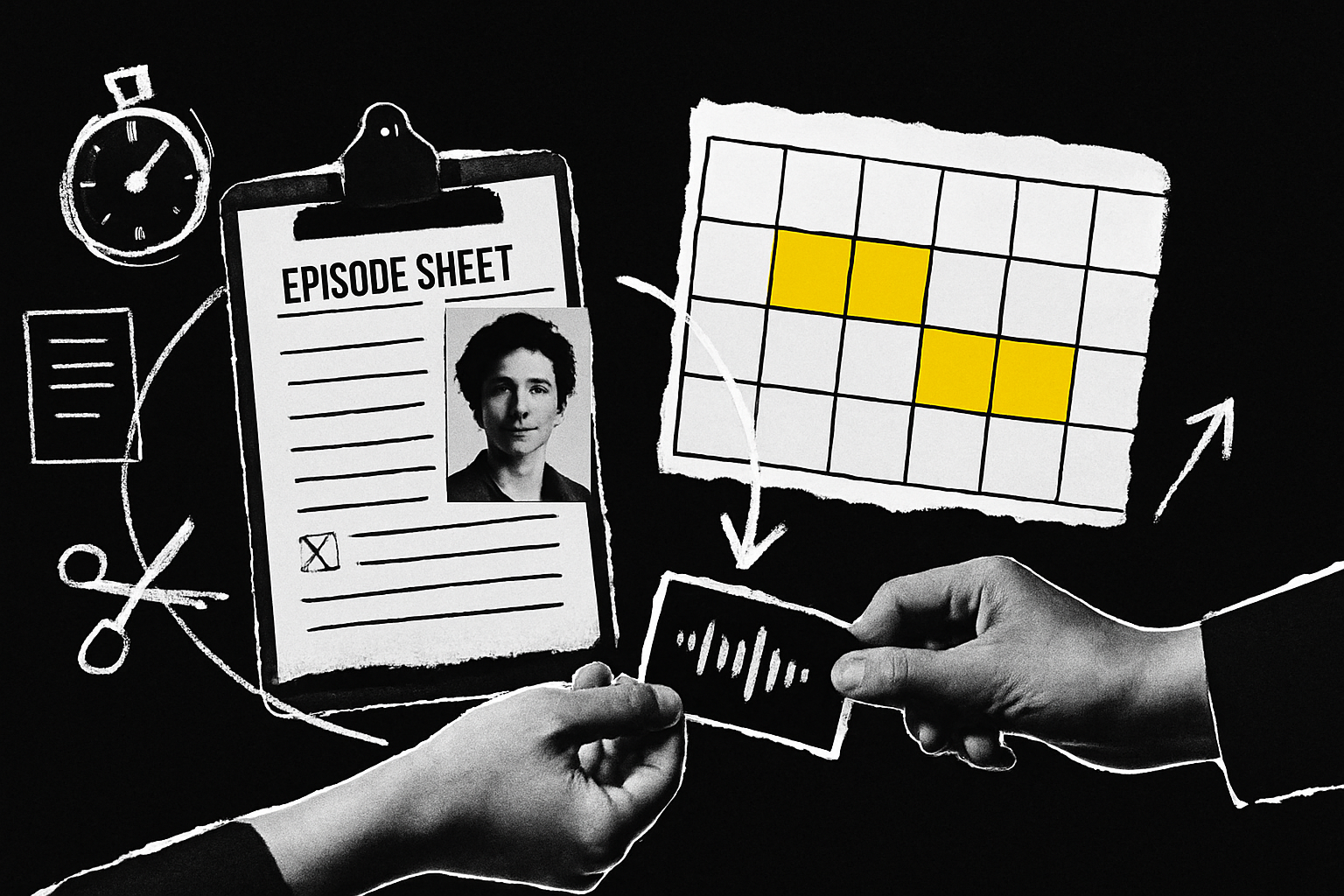
A podcast producer owns the show from idea to published episode. They shape the format, book and brief guests, run the recording session, direct the host, oversee editing and publishing, and turn each episode into promotional assets. An editor makes the audio sound good. A producer decides what the episode is, whether it worked, and what happens to it next.
That distinction is where most B2B shows quietly fall apart. The company hires editing, calls it production, and then wonders six months later why the show sounds fine and does nothing.
What does a podcast producer do day to day?
The job splits into three phases, and the day-to-day work looks completely different in each.
Before the recording, the producer decides what the episode is. That means setting the format and structure (cold open, theme, interview, voiceover segments), choosing the topic, researching the guest and the subject, booking the guest and coordinating diaries, writing the question set, and briefing the host on where the conversation needs to go. Producers with a radio background describe this as the part of the job that nobody outside audio can picture: they can hear the finished episode before it exists, and they build the recording around that.
During the recording, the producer runs the room. They direct the host, manage the guest’s technical setup, watch for the moment that will open the episode, and catch the answer that needs to be asked again because it started with throat-clearing. Guests and hosts both treat the producer as the expert on how to perform well, so the job includes coaching people who are nervous, over-prepared, or answering as if they are on a sales call.
After the recording, the producer owns the output. Editing for flow and pacing, sound design and music, levelling, metadata and ID3 tags, a final quality listen, show notes and transcript, upload and scheduling, and the check the day after publishing that the episode actually appeared correctly on Apple Podcasts, Spotify and YouTube. Then the promotional layer: clips, social copy, the blog version, the email. And then reporting on what the numbers did and recommending what to change.
Across all three phases sits project management, which is the part nobody puts on a job spec and everybody underestimates. A producer running a fortnightly show is holding a rolling calendar of guests at different stages of confirmation, recordings booked weeks out, episodes in edit, assets in review, and a publishing schedule that cannot slip. Producers describe themselves as serving three groups at once: the business paying for the show, the guests who need a good experience, and the audience who owe you nothing.
Is a podcast producer the same as an editor?
No, and conflating the two is the most expensive mistake in B2B podcasting. An audio editor takes a recording that exists and makes it better. A producer decides whether that recording should have existed, in that format, with that guest, on that topic.
The roles genuinely overlap in practice. Some producers come from radio and focus on story and structure. Others are engineers and editors first, and their strength is making audio sound excellent. A third group does both and adds content strategy on top. There is even a hybrid title, “preditor”, for the person who can conceptualise the content and then build it end to end. What matters when you are hiring is knowing which of those you are buying, because the words on the invoice will say “podcast production” in all three cases.
Here is the practical split.
| Area | Audio editor | Podcast producer |
|---|---|---|
| Show format and structure | Follows the brief | Sets it |
| Topic and guest selection | Not involved | Owns it |
| Guest booking and briefing | Not involved | Owns it |
| Recording session | Usually absent | Directs it |
| Cutting, levelling, sound design | Owns it | Oversees it |
| Show notes, publishing, scheduling | Sometimes | Owns or delegates it |
| Clips, social, distribution | Sometimes | Owns the plan |
| Performance review and changes | Not involved | Owns it |
| Accountable for the show working | No | Yes |
The last row is the whole argument. An editor is accountable for a file. A producer is accountable for a show.
Do you need a producer if you already have an editor?
If your editor is turning around clean episodes on time and your show is not doing anything for the business, you do not have an editing problem. You have a production problem, and adding more editing will not touch it.
Run through what is actually happening on your show. Who decides which guests go on, and on what basis? If the answer is “whoever the host knows” or “whoever said yes”, the show has no guest strategy, and a guest list without a strategy produces episodes your buyers have no reason to listen to. Who briefs the guest before the call? If nobody does, you are paying an editor to rescue a conversation that started cold. Who watches the first ten minutes of the recording and decides the episode needs a different opening? Who turns the episode into the six assets that carry it beyond the feed? Who looks at what happened after publishing and changes something?
Those are producer jobs. In-house, the host usually absorbs them by default, which works until the host has a busy quarter. The show slips a week, then two, then becomes a batch of four episodes recorded in one exhausted afternoon, and the quality gap is audible.
There is a version where you do not need a separate producer: the host who is genuinely also the producer. Host and producer are frequently the same person, and for a founder-led show with a narrow topic and a confident presenter, that can hold. It holds as long as that person has the hours, and the volume of tasks is what usually breaks it. The moment a show becomes something the business is counting on for pipeline, the production work needs an owner who is not also the talent.
Is a producer worth it for a fortnightly show?
A fortnightly show is exactly where a producer pays for themselves, because 26 episodes a year is enough volume to need a system and not enough to survive without one.
Do the arithmetic on a single episode. Guest identification and research, outreach and booking, scheduling across two or three diaries, a pre-call or written brief, the recording itself plus setup, a producer listen-through and edit direction, the edit, show notes and transcript, clip selection, social copy, upload and scheduling, and the post-publish check. Whoever does that inside your company is spending most of a working day per episode, and at fortnightly cadence that is roughly two days a month of a senior marketer’s time, minimum, before anyone has written a word of promotion. Ask what else that person would be doing with those days.
The failure mode is not that the episodes stop. It is that the deliberate parts go first. Guest briefing gets dropped, so conversations get generic. Clip selection gets skipped, so nothing leaves the feed. The performance review never happens, so nothing improves for a year. The show keeps publishing and steadily stops earning its place.
Weekly shows need a producer without much debate. Monthly shows can sometimes run on a good editor plus a disciplined host, because there is enough slack in the calendar to absorb a bad week. Fortnightly is the awkward middle, and it is where most B2B shows land.
What does a producer do that actually drives pipeline?
For a B2B show, the producer’s most valuable decisions happen before anyone records anything, and they are commercial decisions rather than audio ones.
The first conversation a good producer has with you should barely mention the podcast. What does the company sell, who buys it, what does the buying committee look like, why do deals stall, and what is the show supposed to do: build the founder’s profile, open doors at named accounts, collect customer stories, or something else. Format, length and style come after that, because the answer changes all of them. A show built to open doors at 200 target accounts needs a guest list drawn from those accounts, not a guest list drawn from whoever has a large following.
That is the part in-house teams most often skip, and it is the part that decides whether the show produces conversations. B2B Better works as a podcast agency on exactly this problem: making the guest strategy and the point of view do commercial work, so the show generates relationships with people who would not have taken a sales call.
The producer’s second commercial job is the asset layer. An episode that lives only in the podcast feed reaches the people who already subscribe. The producer decides which two minutes of a 40 minute conversation are worth clipping, what the LinkedIn post says, whether the episode becomes a written piece, and which sales conversations it should be sent into. Distribution work is where most of the return sits, and it is the first thing dropped when the host is also the producer.
The third is the feedback loop: reading the analytics, reporting on engagement, and recommending changes to the show. That means noticing that episodes with customers outperform episodes with analysts, that the 12 minute mark is where listeners leave, or that one guest category keeps producing follow-up meetings. Without someone accountable for that, you run the same show for two years and call the result inconclusive.
What skills should you look for in a podcast producer?
Audio editing and recording ability, storytelling and writing, research, and a working understanding of marketing and business. On the interpersonal side: organisation under multiple deadlines, project management, communication that is closer to over-communication, and the ability to become passably expert in the subject matter you are producing, quickly.
For a B2B show, weight that list differently from how a media company would. Technical audio skill is the easiest thing to buy and the easiest to outsource. What is hard to find is a producer who can sit with your VP of Product, understand your category well enough to spot a lazy answer, and know which bit of the conversation your sales team will actually use. Producers working with enterprise tech clients need to speak the client’s language, and a producer who cannot hold a credible conversation about your market will produce episodes that sound like every other episode in your category.
Formal qualifications matter less than portfolio. Plenty of producers learned by launching their own shows rather than through a degree, and the standard tools are Adobe Audition, Audacity and GarageBand. When you are assessing someone, listen to three episodes they produced and ask them why each one opens the way it does. A producer who can explain the structural choice has done the job. A producer who talks about noise reduction is an editor.
How do you tell whether a producer is doing the job?
Judge output, not effort. Four things tell you inside a quarter.
Episodes ship on the date they were promised, without the host doing a heroic weekend. Guests arrive briefed and leave saying it was the best podcast experience they have had, because guest experience is a direct input to the quality of the conversation and to whether they promote the episode. Every episode produces its promotional assets as a matter of course, not as an occasional extra. And you get a regular read on performance with a recommendation attached, rather than a dashboard link.
If you are getting polished audio and none of the other three, you are paying producer rates for editing.
What drives the cost of hiring a producer?
Cost moves on scope rather than on hours, and the variables are worth naming before you take a quote.
Episode volume is the obvious one, and cadence matters more than total count because a weekly show needs a standing system. Video changes the number substantially: filming, multicam edits and vertical clips are a different production discipline from audio. How much of the front end is included, meaning strategy, guest research and guest booking, is often the biggest single swing, because guest sourcing is slow relationship work. Distribution scope is the other swing: whether you are buying a finished episode or a finished episode plus clips, written assets and a promotion plan. And whether you need a named producer who learns your category or a pooled team working from a template.
When you ask for a quote, ask for the deliverables per episode in writing, who is accountable if an episode slips, whether guest booking is included or billed separately, and what happens to the assets after publishing. Two quotes that look similar in price often differ by half the work.
The honest test for a B2B show is simple. If the producer is only responsible for what comes out of the edit, you have bought post-production. If they are responsible for who is on the show, what gets said, and where it goes afterwards, you have bought a producer, and that is the version that shows up in pipeline.