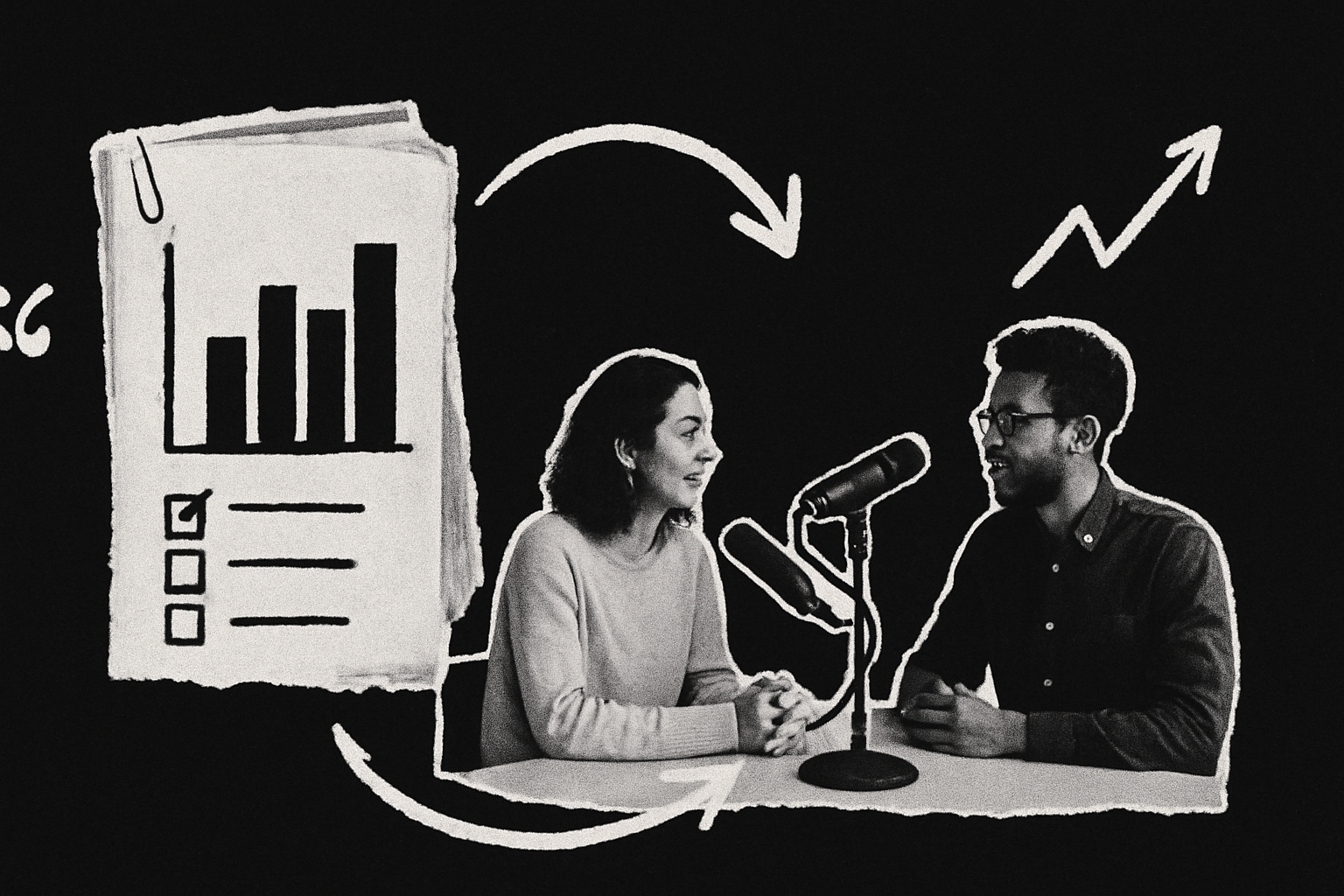
A research report wins on citation and defensibility. A podcast wins on relationships, consistency and reach. If you have to pick one for B2B thought leadership, pick the report when you need a claim the market can quote, and pick the podcast when you need access to the people whose opinions move your deals. Run properly, the podcast produces the raw material for the report.
That answer annoys people who want a single format to carry the whole programme. It should. The two assets do different jobs, and the mistake is not choosing wrong, it is choosing one and expecting it to do both.
Is a podcast or a research report better for authority?
Authority in B2B is built on evidence, and research is the cleanest form of evidence you can own. Cindy Anderson, CMO at the IBM Institute for Business Value and co-author of The ROI of Thought Leadership, draws the line sharply: thought leadership requires data, requires research, requires some sort of independent or second or third-party research that forms the basis of the perspective. Without that foundation, you are publishing opinion.
By that definition, a research report is thought leadership in its purest available form. You commission a survey, you find something the market did not know, you publish it with your name on it. The number becomes a reference point. Hinge Marketing calls original research arguably the most trusted form of thought leadership content, because it provides new insight and reads as objective rather than promotional.
A podcast on its own does not clear that bar. An unstructured conversation with an interesting guest produces a point of view with no evidentiary spine. That is why so many B2B shows feel pleasant and change nothing: they generate perspective without proof.
What a podcast does better is the second and third parts of Anderson’s definition, the subject matter expertise and the inspiration to act. TopRank’s 2026 research with Ascend2, based on just under 800 B2B marketers in the US and UK with 81% in senior leadership roles, found that 73% of marketers who frequently collaborate with influencers rate their research-based content as very effective at driving engagement and leads, against 29% of everyone else. A podcast is the most reliable mechanism in B2B for getting those collaborators on the record, repeatedly, by name.
So authority is not a contest between the two. Research gives you a claim. A podcast gives you the voices that make the claim credible and the distribution that makes it travel.
Which gets cited more often?
Research reports, and by a wide margin. A statistic is a portable unit. Someone writing a blog post, building a slide, briefing an analyst or answering a journalist needs a number with a source attached, and they will lift yours. A 45-minute conversation offers nothing liftable unless someone does the work of extracting it.
This matters more now that discovery has moved. TopRank’s research found 32% of professionals discover thought leadership through GenAI tools like ChatGPT and Perplexity. Language models cite what is structured, specific and attributable. A stat with a methodology note and a named publisher is exactly that. An audio file is not, and even a transcript buried on a podcast host’s player is a weak citation target compared with a report page that states a finding in a sentence.
The practical consequence: if your goal is to be the source other people quote, a report is the asset that gets you there. If your goal is to be the brand buyers already recognise when they reach the shortlist, episode cadence does more work.
There is a sharper version of this point. Original research published behind a form captures leads and surrenders citations. Column Five’s analysis of the same tension notes that a research report plays both roles at once, with the gated PDF working as a lead gen asset and the argument working as thought leadership when distributed ungated. Those roles pull in opposite directions. TopRank published its own 2026 report ungated and interactive, which is the trade most companies should make if citation is the objective.
Can a podcast feed a report?
Yes, and this is the most underused sequence in B2B content.
The hard part of original research is rarely the survey platform. It is knowing which question is worth asking. You need a hypothesis specific enough that the answer will surprise someone, and you need to know which cuts of the data your buyers will argue about. That knowledge comes from talking to 30 or 40 practitioners about the same problem.
A podcast is a structured excuse to have those conversations, on the record, with people who would not take a sales call. Run it with intent and the sequence looks like this:
- Ask every guest two or three identical questions across a season, alongside the conversation they came for.
- Code the answers. Patterns emerge: a shared assumption, a disagreement that splits by company size, a practice everyone claims and few execute.
- Turn the strongest pattern into survey questions and field it quantitatively.
- Publish the report with guest quotes as the qualitative layer, and bring the contributors back on the show to react to the findings.
That last step is where the compounding happens. TopRank’s 2026 report featured insights from eight named B2B marketing leaders alongside the survey data, including Anderson, Ty Heath of LinkedIn’s B2B Institute, Janine Wegner of Dell Technologies and Brian Solis of ServiceNow. Those contributors have a reason to share a report that contains their own thinking. The podcast is how you earn that relationship before you need the favour.
The reverse also works, and is easier. Publish the report, then spend a season interviewing people about its findings. Every episode is a fresh angle on an asset you already paid for, and the report stops being a one-week spike.
How do the two formats actually compare?
| Podcast | Research report | |
|---|---|---|
| Primary output | Relationships and recurring reach | A citable, defensible claim |
| Evidence base | Guest experience and your point of view | Primary data you commissioned |
| Citation potential | Low unless transcribed and excerpted | High, the native unit of B2B citation |
| Cadence | Weekly or fortnightly, compounds slowly | Once or twice a year, spikes hard |
| Sales usefulness | Invites conversations with named accounts | Gives sellers a reason to send something useful |
| Main failure mode | Pleasant chat with no argument | Survey that confirms what everyone knew |
| Visibility in AI search | Weak as audio, workable as transcripts and articles | Strong, structured and attributable |
| What it needs from your execs | An hour a fortnight of their time | A point of view they will defend publicly |
The row that decides most budgets is the last one. A report demands a position. If your leadership team will not commit to an argument the market might push back on, you will commission research and publish a deck of unobjectionable charts. Hinge is blunt about this: content that restates conventional wisdom is common and is not thought leadership.
Which should you choose first if you can only fund one?
Choose the podcast when access is your constraint. If you sell to a market of a few hundred named accounts, or you are entering a category where nobody knows you, the show is a legitimate reason to put an hour on the calendar of someone senior who has no other reason to speak to you. You cannot buy that with a report, and the relationship outlasts the episode.
Choose the report when consensus is your constraint. If buyers keep agreeing with your pitch and then doing nothing, you have a belief problem, and belief moves on evidence. Evidence that the status quo is costing them something specific is what breaks the stall. Hinge’s research on professional services firms found creating valuable content was the number one marketing priority, and the firms that act on that priority with primary data get a different class of attention than the ones publishing another guide.
Also weigh who will actually do the work. A podcast asks for a small amount of executive time at high frequency, forever. A report asks for a large block of time and a willingness to be wrong in public, once or twice a year. Teams fail at podcasts when the host loses interest in month four, and they fail at research when the exec who owns the argument goes quiet during review.
There is a budget dimension too, and it does not resolve neatly. Podcast cost is driven by episode volume, whether you produce video or audio only, how much editing and repurposing is in scope, and whether guest research and booking sit with you or with a partner. Report cost is driven by sample size, how many markets and segments you need to cut the data by, whether you use a research panel partner, and how much design and interactive build the output requires. Ask any supplier to break the quote down along those lines. A single number with no variables attached tells you nothing about what changes when your scope does.
What does the buyer evidence say about either format?
The case for thought leadership generally is stronger than the case for any specific format, which is why format arguments are usually a distraction.
Column Five cites the Edelman and LinkedIn 2025 B2B Thought Leadership Impact Report: 75% of decision-makers say thought leadership has prompted them to research products they had not previously considered, 70% of C-suite executives say it has led them to reconsider their current vendor relationship, and 86% say they are likely to invite consistent thought leadership creators to RFPs. That last figure is the one worth pinning to the wall, because of the word consistent. Invitations go to brands that show up repeatedly, which favours a format you can sustain over one you publish annually.
On the research side, TopRank found 93% of B2B marketers using original research based content feel it is effective at driving engagement and leads, with 48% rating it very effective. And 97% say thought leadership is critical to full-funnel success while only 43% extend it beyond acquisition into engaging and retaining existing customers. A report tends to be fired at the top of the funnel and then forgotten. A podcast runs the length of the relationship, which is partly why we built B2B Better as a B2B podcast agency rather than a content studio: the show keeps working after the deal closes, in a way a PDF does not.
One more number from TopRank worth acting on: 78% of marketers say interactive and experiential content increases repeat engagement, but only 33% regularly build it into campaigns. A static PDF is the least experiential form your research can take. Turning findings into an interactive page, a set of episodes where practitioners argue about the data, and clips your sales team can send is where the second and third rounds of value live.
How should you sequence both over twelve months?
Start the podcast. It has the shorter lead time, it builds the relationships you will need later, and it forces your executives to practise saying what they think out loud before you ask them to defend it with data.
Through the first two quarters, ask every guest the same small set of questions. Keep notes on where they disagree. By the end of the second quarter you should be able to write the one sentence your research needs to test, and you should have a list of contributors who will give you a quote and share the result.
Field the survey in the third quarter. Publish ungated, with an interactive version if budget allows, and with the findings written as quotable sentences rather than chart captions. Then spend the fourth quarter running episodes on the findings, with the people who contributed and with people who will disagree. The report feeds the show. The show redistributes the report. Neither asset has to carry the programme alone.
The thing to avoid is the sequence most teams default to: commission research because a competitor did, publish it behind a form, generate a list of unqualified downloads, and have nothing to say for the following eleven months. That outcome is not a format failure. It is what happens when the asset was never attached to an argument or to a mechanism for keeping the argument in front of buyers.
Pick the format that fits the constraint you actually have. Then build the other one from what the first one teaches you.