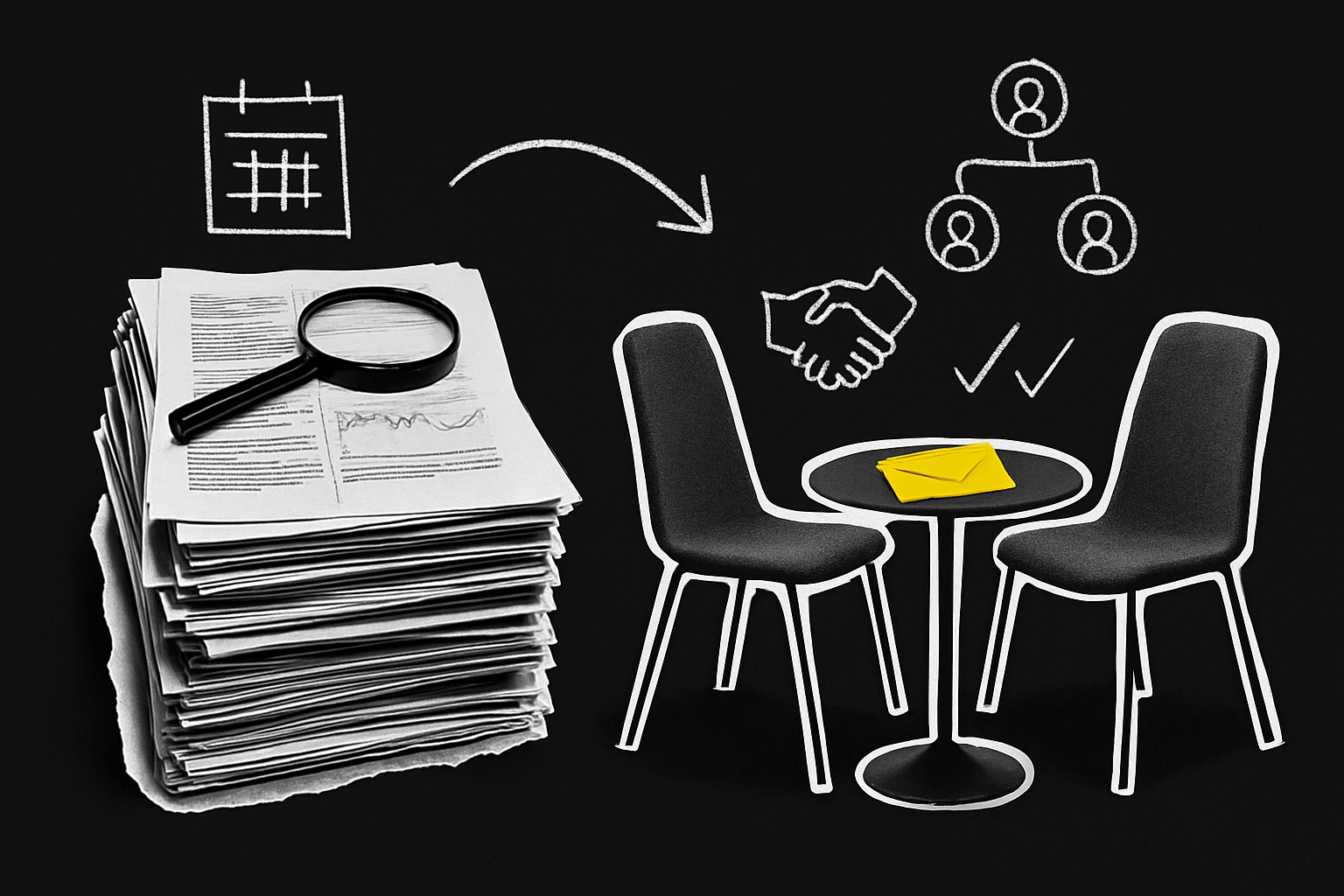
Yes, a podcast works for account based marketing, and the mechanism is simple: you build a show around the persona you sell to, then invite named people from your target account list to be guests. The invitation offers them a platform instead of a demo, so it gets accepted by people who ignore everything else. The conversation gives you discovery you would never get on a first sales call.
That is the whole play. What follows is how to run it so it holds up, and how to tell early whether it is working.
Why does the invitation get through when nothing else does?
Reaching a senior buyer has become a volume problem that volume cannot solve. AI-written emails, automated connection requests and a queue of vendors have made enterprise inboxes close to unusable, and the tactics that still land are the ones that take real human effort and do not scale. A podcast invitation is one of the few asks that gives before it takes.
Compare the two messages sitting in the same inbox. One asks for 30 minutes to walk through a platform. The other says you run a show featuring the top people in their category, you distribute it across your channels, and you want to feature them because of what they have built. The second one costs the recipient nothing in dignity. It gives them exposure, a link to send to their team, and something that reads well on a profile. That is why it gets a yes.
Bev Burgess, who named account based marketing in 2003 after seeing Accenture and Unisys assign marketers to individual accounts, defines it as treating an individual account as a market in its own right, with partnership with sales as one of its principles. A show that features your buyers fits that definition better than most ABM tactics, because every episode is a one-to-one engagement with named people inside a named account, produced with the account team rather than at them.
Can a podcast be used for ABM, or is it just brand marketing wearing a badge?
It becomes ABM when the guest list is the target account list. Without that, you have a content programme with a nice audience and no account coverage.
The distinction matters because a lot of what gets called ABM is not. Davis Potter of ForgeX puts it bluntly: building lists off third-party intent and running ads at them is better demand gen, not ABM. A podcast fails the same test in the same way. If your booker is chasing whoever has the biggest following, you are buying reach. If your booker is working from the 20 accounts your sales team has committed to, you are running ABM with audio as the engagement vehicle.
Stephanie Quinn of Demandbase describes the crawl phase of ABM as one rep, 10 to 20 accounts at most, and then omni-channel coverage against that same list so you get what she calls multi-channel lift: engagement rates at account level rise when display, paid social and search all hit the same accounts at once. Slot the podcast into that stack. The show gives you something the ad channels cannot, which is a reason for a human at the account to spend an hour with a human at your company. The ads make your name familiar before the invitation lands. The invitation converts familiarity into a conversation.
Buying groups change the arithmetic in your favour. Quinn points out that mid-market deals can involve five to eight players and enterprise deals eight to fifteen or sixteen stakeholders. One guest does not cover a buying group. Three or four guests from the same account, recorded across a quarter, does start to. A podcast is one of the few tactics where you can go back to the same account repeatedly with a fresh, welcome reason to make contact.
Does inviting a target buyer on the show actually work?
It works when the show is real and it fails when it is a wrapper. The test a prospective guest applies takes about 40 seconds: they look at the feed, check who else has been on, look at whether episodes get promoted, and decide whether being associated with it helps or embarrasses them.
So the show has to exist before the ABM programme does. A feed with three episodes, all featuring your own executives, does not carry an invitation. A feed with twenty episodes featuring people your target guest recognises carries it easily, because the ask becomes “join a group you already respect” rather than “be our first experiment”. Early episodes should go to people who will say yes fast: customers who like you, advisors, the well-known voices in your category. Those episodes are the credential you spend later on the accounts that matter.
Bernie Borges ran the Modern Marketing Engine podcast on exactly this basis. His stated strategy was relationship building with marketing executives at B2B brands, delivered by providing a platform to feature them. Some of those guests became clients of Vengreso. His point about his earlier show is the useful one: the first podcast had no strategy, he recorded it for fun and hoped something good would come of it, and hope is not a strategy. The difference between a show that produces pipeline and one that produces downloads is whether the guest list was chosen on purpose.
The other reason it works: you learn things. A pre-record call plus an hour on tape with a senior buyer surfaces their priorities, their language, the projects they are defending internally and sometimes the vendors they are weighing up. You cannot get that in a discovery call because a discovery call puts them on guard. You get it in an interview because you are asking them to explain their thinking to an audience, which is a thing senior people enjoy doing.
How do you avoid it feeling like a pitch?
By not pitching. That sounds obvious and it is the part most programmes get wrong within three episodes, usually because someone in sales asks to sit in, or because the host starts steering towards the problem your product solves.
Four rules hold the line:
- Keep the host out of the sales conversation. The person who interviews the guest should not be the person who later asks them for a meeting. Separate the roles and the guest never has to wonder which conversation they are in.
- Let the guest talk about their work, not your category. If your product is procurement software and the guest wants to talk about how they rebuilt their supplier onboarding, that is the episode. Their story is the value you promised them.
- Promote the guest harder than you promote yourself. Clip the episode, tag them, send them the assets, share it with your network. This is the part that makes them invested in your brand whether or not they ever buy.
- Make no ask on the call and none in the follow-up. The follow-up is the published episode and the promotion around it. If your product comes up because they raise it, answer plainly and move on.
Weaving discovery questions into a genuine conversation is legitimate; interrogating a guest is not. The difference is whether the question serves the listener. “How did you get budget approved for that?” is a great question for an audience of peers and it happens to tell you exactly how procurement works at that account. “What are you currently using for X and when does the contract renew?” serves nobody but you, and the guest will notice.
One more thing that protects the show: keep publishing episodes that have nothing to do with your pipeline. A feed made entirely of live opportunities reads as a sales funnel with an RSS address. A feed that mixes prospects, customers, analysts and people who will never buy from you reads as a programme, because it is one.
Where does the podcast sit against the other ABM plays?
Gifting, private dinners and hyper-personalised research all work, and they work differently. David Politis, who ran a CIO dinner at Eleven Madison Park that cost $20,000 and produced roughly $3 million in revenue, lists the podcast as one of eight tactics that cut through, alongside relevant personalised gifts, once-in-a-lifetime experiences, deep research, referrals from champions, confidential roundtables, personalised demo environments and letting prospects choose their own experience. The honest comparison looks like this.
| Play | What it gets you | What it costs you | Reusable? |
|---|---|---|---|
| Podcast guest invitation | An hour with a named buyer, plus discovery and a published asset | Ongoing production and booking effort | Yes, the episode keeps working and the relationship carries on |
| Personalised gift | Recall and a reply | Research time per person, plus the gift | No, one-shot per contact |
| Executive dinner or roundtable | Peer conversation across several accounts at once | Venue and hosting spend, plus a curated guest list | No, though relationships persist |
| Personalised research document | A pitch that proves you understand their world | Research and writing per account | Partly, the format reuses, the content does not |
The podcast’s advantage is that it produces an asset with a second life. A dinner happens once. An episode is a permanent, public thing the guest shared with their own network, which means it keeps introducing you to people who look like them. Its disadvantage is cycle time. Booking, recording, editing and publishing takes weeks, so it is a poor choice if you need a meeting with a specific person before the end of the quarter. For that, send the gift.
Politis is also clear on the economics of ABM generally: as a rule of thumb, if your average contract value is below $50,000, most of these tactics do not make sense. Apply that to the podcast honestly. The effort per guest is real, and it has to be paid for by deal size.
What does it cost and what actually moves the number?
Nobody can quote you a credible figure without knowing the shape of the programme, so be suspicious of anyone who does it in a first call. The variables that move the cost are worth understanding before you brief anyone:
Episode volume and cadence set the baseline. A fortnightly show is roughly half the production load of a weekly one, and for ABM purposes fortnightly is often enough, because your constraint is how fast you can book senior guests from a 20-account list, not how fast you can edit.
Video multiplies everything. Audio-only is cheaper to produce and easier for a busy executive to agree to. Video gives you clips that work on LinkedIn, which is where the guest promotion actually happens. If clips are the point, budget for video from the start rather than retrofitting it.
Guest booking is the line item people underestimate and the one that decides whether this is ABM at all. Chasing a CIO at a target account takes persistence, warm paths and follow-up over weeks. If nobody owns that, the guest list will drift towards whoever is easy to book, and the programme quietly turns into general content marketing.
Distribution scope is the other swing factor: whether you are paying for editing and publishing only, or for the clips, the guest promotion pack, the newsletter and the sales follow-up sequences that turn an episode into account engagement.
Strategy and positioning work up front costs money once and saves it repeatedly, because it is what stops you launching a show that your target guests would not want to appear on. When you get quotes, ask for them broken down by these five variables. A number without that breakdown tells you nothing about what you are buying.
How do you measure it without hiding behind downloads?
Measure account coverage, not audience. Downloads tell you almost nothing about whether the programme is working, and a show aimed at fifteen stakeholders inside six accounts can be commercially excellent with an audience you would be embarrassed to publish.
Track the things that connect to the account list. How many target accounts have at least one recorded guest. How many stakeholders inside each account you have now engaged, measured against the size of the buying group. Acceptance rate on invitations, split by how warm the account was. Whether engagement from the account rises after publication across your other channels, which is the multi-channel lift effect showing up. Meetings that trace back to an episode, and the time from recording to first sales conversation.
Potter’s warning about signal-based measurement over legacy lead scoring applies here. A guest is not a lead and forcing one into your MQL model will make the programme look like a failure. Treat a recorded episode as an account engagement signal of unusual quality, then report on pipeline progression inside those accounts rather than on volume.
Give it enough time to be judged fairly. Bookings take weeks, episodes publish after that, and enterprise cycles run longer still. Judging an account based podcast on its first quarter measures your booking speed, not the play.
When is this the wrong play?
Do not run it if your average deal is small. The effort per guest does not survive a low contract value, and Politis’s $50,000 rule of thumb is the right instinct.
Do not run it if nobody senior will host. The host has to be credible to the guest, curious in the conversation and disciplined enough not to sell. A junior marketer reading questions off a script produces an episode the guest will not share, which removes the main reason to do this.
Do not run it if sales will not co-own the list. ABM closes the gap between sales and marketing, and a guest list marketing built alone will not match the accounts sales is working. Agree the list together, review it monthly, and let reps nominate guests.
Do not run it if you need meetings this month. Start with gifts, referrals from champions or a roundtable, and build the show in parallel for next quarter.
Helping B2B service and technology companies turn a point of view into pipeline is what we do at B2B Better, a B2B podcast agency, and the account based version of this work is the most demanding kind: the guest list is short, every invitation matters, and the show has to be good enough that a CIO is glad they said yes. Get those three things right and the podcast becomes the reason your target accounts take your call. Get them wrong and you have a content calendar with a microphone attached.
The stakes are straightforward. Your competitors are sending the same emails to the same fifteen stakeholders you are. One of you will find a reason those people want to talk. A show built around them is the cheapest reason available.