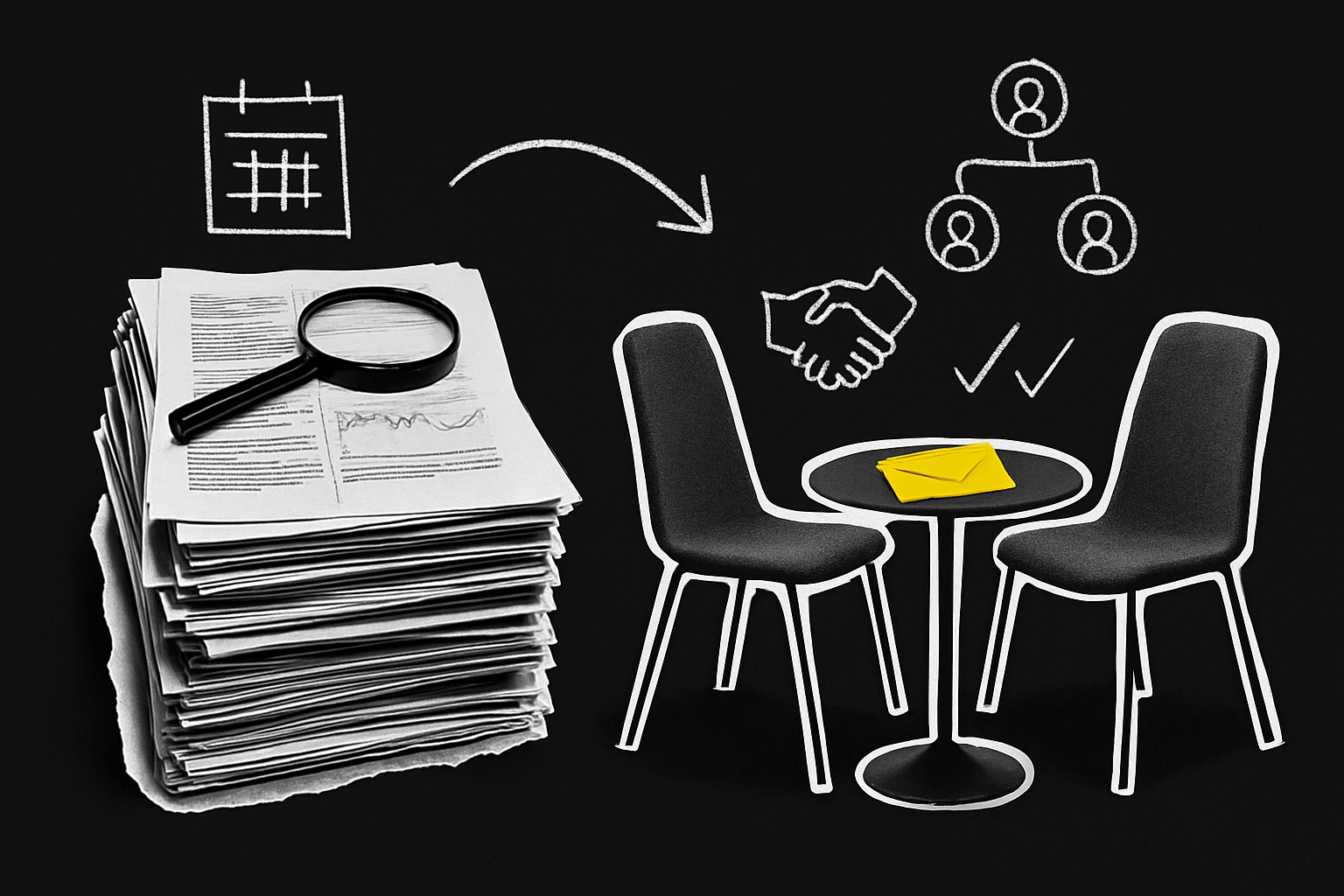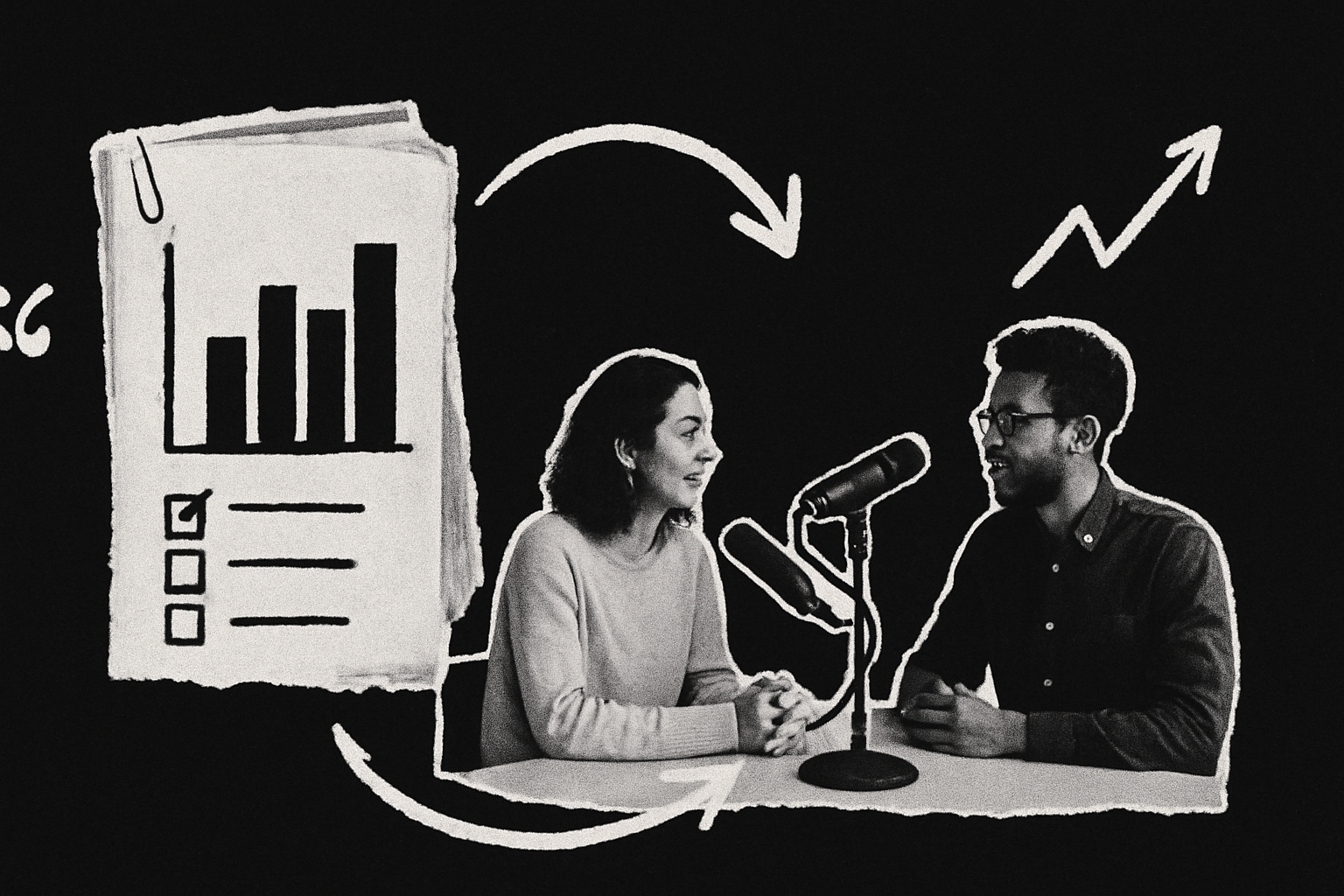
Paid social buys reach you stop receiving the day you stop paying. A podcast builds an asset you keep. For B2B teams with long sales cycles and a small number of high-value accounts, the podcast is usually the better long-term investment and paid social is the better short-term one, which is why the sharpest answer to podcast vs paid social for B2B is to run the podcast as the engine and paid social as the amplifier.
That is the conclusion. The rest of this page is the reasoning, because the choice depends on what is actually broken in your pipeline right now.
What are you really buying with each channel?
Paid social buys distribution. You pay a platform to place a message in front of a defined audience, and LinkedIn lets you pick that audience by job title, industry, company size and other firmographic signals that matter when a buying committee has eight people on it. The precision is real. So is the speed: a campaign can be live tomorrow and producing engagement by Friday.
A podcast buys attention and relationships. Listeners opt in and give you their time willingly, which is a different proposition from an ad someone swipes past in a feed. A 45-minute conversation with a CEO shows how your leadership thinks in a way a 300-character ad cannot. And every episode you record stays recorded.
The economics differ in a way that gets glossed over. Paid social has a media spend line that resets to zero every month. Organic and owned content has a time-and-content cost instead, and no media spend at all. That distinction is the whole argument about compounding, and it is where most budget decisions go wrong.
There is a third thing a podcast buys that paid social structurally cannot: access. When you invite a VP of Operations at a target account onto your show, you are asking for an hour of their time in exchange for a platform, not in exchange for a demo. People who ignore ads and delete sequences say yes to that. The guest list becomes a target account list you have earned warm conversations with, and no amount of ad spend replicates it.
Podcast vs paid social for B2B: the honest comparison
| Podcast | Paid social | |
|---|---|---|
| Primary job | Trust, authority, access to named accounts | Targeted reach, speed to pipeline |
| Time to first result | Slow, builds over months | Fast, days to weeks |
| Cost structure | Time, production, distribution effort | Media spend plus creative |
| What happens when you stop | Back catalogue keeps working | Reach ends immediately |
| Targeting | Chosen through guests and topics | Job title, industry, company size, account lists |
| Attribution | Hard, indirect, shows up in sales conversations | Measurable, though multi-touch is messy |
| Best use | Consideration, differentiation, relationship building | ABM, retargeting, launches, short-term acceleration |
Read that table as a division of labour rather than a scoreboard. Roughly 81% of B2B marketers invest in paid social, and paid social contributes around 12.6% of total pipeline. Both numbers are worth sitting with. Almost everyone is buying the same inventory, targeting the same job titles, with variations of the same message. Against that backdrop, the channel that carries your actual thinking becomes the differentiator, and the channel that carries your offer becomes the way you get in front of people faster.
Is a podcast cheaper than paid social over time?
Over a long enough horizon, yes, though not in month one and not if you count it wrong.
Compare the shape of the two costs. Paid social is a recurring media buy. Spend the same amount next quarter and you get roughly the same amount of reach, with no accumulated advantage, and if you pause, delivery stops that afternoon. Podcast costs are front-loaded into production and process: recording, editing, show notes, clips, distribution. Once that machine runs, the marginal cost of episode 40 is lower than episode 4, because the format, the guest pipeline and the repurposing workflow already exist.
The variables that move a podcast budget are worth naming, because they are the ones you will be quoted on: how many episodes a month, whether you shoot video as well as audio, how much distribution and repurposing is included, whether guest research and booking sit with the agency or with you, and whether strategy and positioning work happens before recording starts. Each of those pushes the number in a predictable direction. Video with multi-camera setup costs more than audio. Twelve episodes a quarter costs more than four. A production-only engagement costs less than one that includes booking your ideal customer profile onto the show and turning each episode into a fortnight of social content.
The honest caveat: a podcast has a real internal cost that never shows on an invoice. Your CEO or subject matter expert has to show up, prepared, every fortnight, for a year. If that person cannot commit, the podcast is more expensive than paid social, because you will pay for production and get nothing usable.
Which one compounds?
The podcast compounds. Paid social accumulates familiarity while you keep paying, and that is a different thing.
Compounding in content means each new unit increases the value of the units already published. A podcast does this through several mechanisms that have nothing to do with download growth. Episode titles, descriptions, show notes, transcripts and supporting blog posts all contribute to search visibility, so a conversation recorded in March is still being found through search in November. A single interview generates short clips, LinkedIn posts, blog articles, quote graphics, email content and YouTube Shorts, which means the library you are building is a content supply that your team draws down on instead of starting from a blank page every week. And the guest relationships stack. A guest may become a partner, a referral source, or an introduction to the next guest.
Paid social does have a compounding-adjacent effect. Its value sits largely in incremental progress, nudging thousands of prospects forward long before they raise their hand, and that familiarity does build. But it builds on rented land. Cut the budget and the effect decays, because the asset was never yours. The distinction between owned audience and rented audience is the one that matters when the CFO asks what you have to show for the year.
The catch on compounding is that it only works with consistency. Posting once a week, or worse once a month, leads to minimal engagement and lost momentum. A podcast published erratically compounds nothing. A simple, repeatable system sustained over time outperforms bursts of activity you cannot maintain, and that is as true of a show as it is of a posting schedule.
Can a podcast reduce your paid spend?
It can, through three specific routes, and it is worth being precise about them because “podcasts lower CAC” on its own is a claim with nothing under it.
The first route is creative supply. Paid social stagnates when companies launch with one version of creative and never test variations. A podcast produces a continuous stream of raw material: clips, arguments, specific claims from real practitioners. Feeding that into paid means you are testing genuinely different messages rather than rotating colour variants of the same ad, and better creative brings your cost per result down without touching the budget.
The second is warm retargeting. Most B2B buyers do not convert on first interaction, and paid social retargeting keeps you visible to people who already engaged. Podcast listeners and episode-page visitors are a far better retargeting pool than people who bounced off a pricing page, because they gave you twenty minutes of attention first.
The third is what happens before the sales call. A prospect who found you through an episode, watched a few clips, read the article built from the conversation and then visited your site arrives with context. The first conversation is not cold. Familiarity shortens sales cycles and improves conversion rates, and a shorter cycle at a higher conversion rate means you need fewer leads to hit the same number, which is the only durable way to spend less on media.
What a podcast will not do is replace paid social in a quarter. If your board needs pipeline by the end of the month, run the ads. The podcast is what stops you needing to run them at that volume forever.
When should you put the money into paid social instead?
Four situations make paid social the right first call, and a podcast the wrong one.
You need speed. Pipeline goals with a short-term deadline are what paid campaigns exist for. Nobody has ever hit a quarterly number with a show that launched in week two.
You are running account-based marketing against a defined list. Paid social lets you put tailored messaging directly in front of specific companies and job titles, which is precision a podcast only achieves one guest at a time.
You are launching something. A new product or service needs to reach the right audience quickly instead of waiting on organic reach that may never materialise.
You have retargeting gaps. Running only top-of-funnel campaigns with no retargeting structure wastes the interest you already generated, and fixing that is usually cheaper than any new channel.
Paid social also fails in predictable ways, and it is worth knowing them before you blame the channel. Broad targeting reduces relevance and raises cost per result. Weak creative testing lets performance flatline. Poor attribution makes it impossible to know what is working, so optimisation becomes guesswork. Most B2B companies struggle with social not because the budget is too small but because they misapply the channels without a clear strategy.
How should you split the budget?
There is no universal 70/30 rule, and anyone quoting one is selling something. Allocation depends on your business goals, sales cycle length, how your audience behaves, how mature your content operation is, and what internal resource you actually have.
A more useful way to decide is to ask what stage your problem sits at. When brand awareness is low and nobody in the market recognises your name, the podcast and top-of-funnel paid work together: the show gives you something worth being known for, the ads make sure the right people encounter it. When the pipeline problem is conversion rather than awareness, shift towards retargeting and decision-stage paid, and let the podcast keep feeding the creative.
Two things to get right regardless of the split. Measure the podcast on something other than downloads. Website visits, branded search activity, inbound inquiries, consultation bookings, referral traffic and partnership opportunities all tell you more than a download chart, and so does the question your sales team can answer directly: how many deals had a guest or a listener in them. Second, do not judge paid social purely on last-click. Much of its value is incremental progress that immediate attribution will never capture, and killing a campaign on a bad cost-per-lead reading is how teams lose the top of their funnel.
As a B2B podcast agency, we end up having a version of this conversation most weeks, usually with a marketing leader whose paid numbers are fine and whose pipeline is not. The pattern is consistent: the ads are reaching the right people and giving them no reason to care. The fix is rarely more spend. It is having a point of view worth spending behind, and a channel that can carry something longer than a caption.
What does this mean for your next quarter?
Run both, and be clear about what each one is for. Paid social is how you reach named accounts quickly and re-engage people who already showed interest. A podcast is how you earn the right to a conversation with the people who never click an ad, and how you build a library that still generates search traffic, sales collateral and warm introductions two years from now.
The risk of choosing only paid social is that you spend three years buying attention and own nothing at the end of it. The risk of choosing only a podcast is that you build something valuable too slowly to save this year’s number. The teams that get this right use the podcast to create the thing worth saying and paid social to make sure the right thirty accounts hear it.
Start with the honest question: if you paused all media spend on Monday, what would still be working for you on Friday? If the answer is nothing, you know which side of the budget needs attention.