Send a guest three things before recording: who listens and what they care about, the two or three areas you will explore (not a script), and the logistics of the session. Then run a 10-minute pre-call to find the story you actually want on tape. Preparation decides the quality of the episode long before anyone hits record.
That is the short answer. The longer one matters because in B2B, the guest is rarely a professional talker. You are booking a CRO who has never been interviewed, a customer who agreed as a favour, or a founder who has been media-trained into saying nothing. Each of those needs a different kind of preparation, and treating them the same is why so many B2B interviews come out flat.
Why do B2B podcast interviews go flat?
The failure is almost always upstream of the recording. A guest arrives with no idea who is listening, so they pitch at a general audience and land nowhere. Or they arrive with a one-page summary of their company’s positioning and read from it. Or they arrive genuinely willing to be useful and the host has done twenty minutes of research, so the questions are the same ones the guest answered on three other shows last quarter.
Every guide on this topic tells hosts to research the guest before recording, and they are right. Listening to a guest’s previous interviews shows you which questions they have already answered to death and which topics are off limits. That research does two jobs: it stops you repeating what has been asked before, and it lets you carry an existing conversation forward into new ground instead of restarting it.
In a B2B setting there is a second failure that consumer podcast advice does not address. Your guest often has something at stake. They are speaking with their employer’s name attached. They have a comms team, a legal team, or a board seat to worry about. Left unprepared, they default to safety, and safety is boring. Preparation is what gives a cautious person permission to be specific.
The stakes are commercial. An episode that goes nowhere still costs you the guest’s hour, the production budget, and the relationship. Guests who have a bad experience do not refer other guests, and guest referrals are the cheapest source of good bookings a B2B show has.
What should you send a podcast guest before recording?
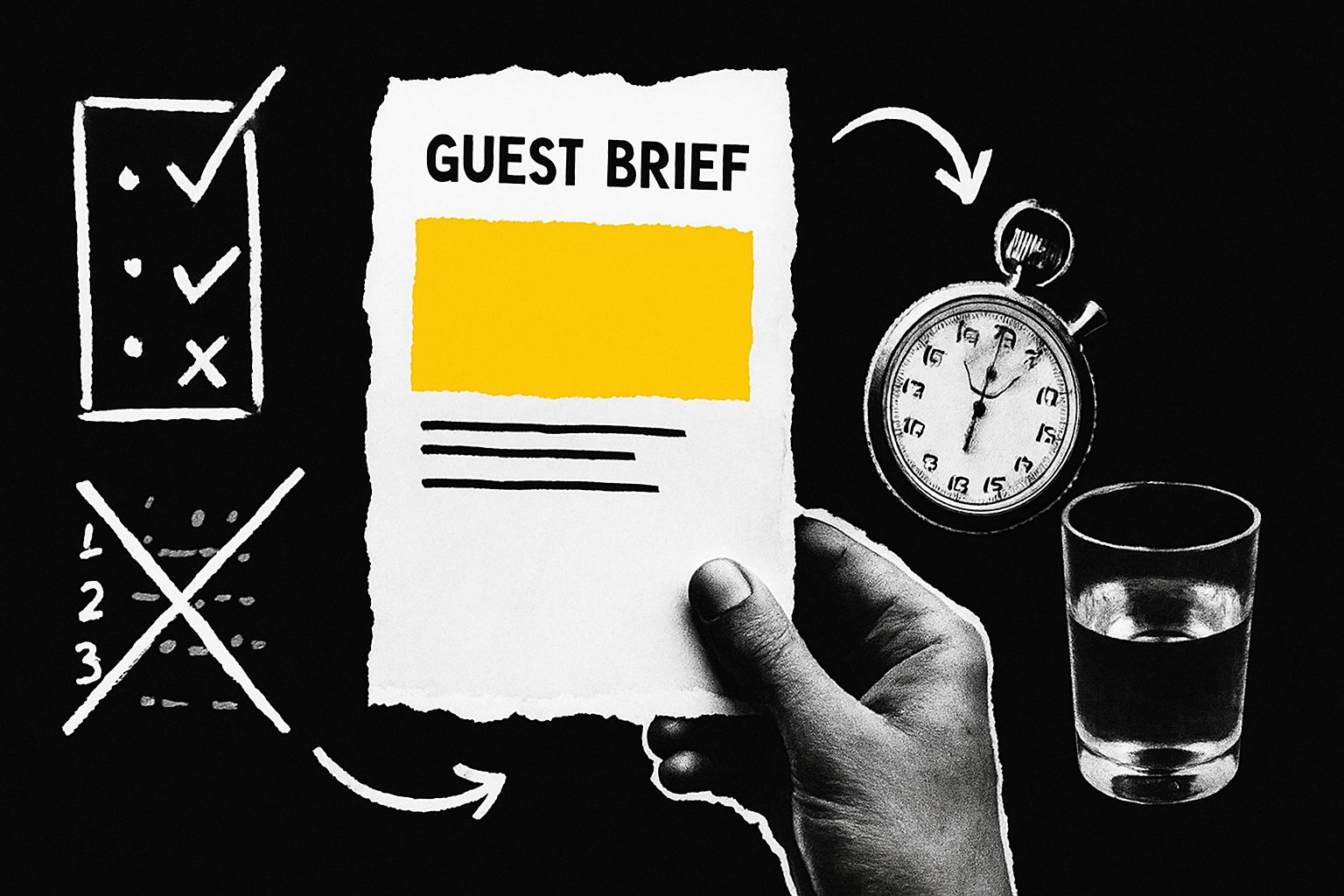
Send a short brief, not a pack. Anything longer than a page gets skimmed or ignored, and a guest who has read four pages of instructions arrives rehearsed rather than ready. The brief needs to do four things.
Tell them who listens. Name the roles, the company size, the problems those people wake up with. A guest cannot tailor an answer to an audience they cannot picture. Ask any experienced podcast guest what makes a host easy to work with and the listener profile comes up first, because a guest who knows they are talking to heads of demand gen at 200-person software firms will pitch every example at that level without being asked. Sending it is a five-minute job that improves every answer in the episode.
Tell them the territory. Three to five bullet points on what you want to cover, framed as areas rather than a script. Bullets keep the conversation loose while still keeping it on topic; a full written script produces a reading, not an interview.
Tell them what you want the listener to walk away with. The single most useful question a guest can ask a host is what the goal takeaway of the conversation is. Answer it before they ask. If you know the episode is about why enterprise renewals stall in procurement, say so, and say what you want a listener to be able to do differently afterwards.
Tell them the logistics. Duration, platform, whether it is video, whether it will be edited, and what happens after. Confirm how to pronounce their name and their company’s name. Ask for the links or references they want mentioned. Send the recording link with a note that headphones are required, because a guest listening through laptop speakers puts your voice back into their microphone and creates echo that is painful to edit out.
Two practical additions that cost nothing: ask them to have water nearby, and tell them explicitly that they can stop, pause, or restart an answer at any point. Guests who do not know they can pause will clear their throat mid-sentence rather than interrupt, and that half-cough half-word is one of the hardest things to edit cleanly.
Should guests see the questions in advance?
Send the themes, not the question list. Every checklist on this topic recommends sending questions ahead so the guest can think and you avoid awkward silences, and the instinct behind that is right. The execution is where it goes wrong. A guest who receives twelve numbered questions will write twelve answers, and an interview conducted from written answers sounds like an interview conducted from written answers. Over-preparation is a recognised guest failure mode: the moment someone is reading a lecture note, they stop connecting with anyone.
What works is a middle position. Send the areas you will cover and one or two sample questions so the guest can recognise your interview style. Rapid-fire hosts and long-reflective-answer hosts require completely different things from a guest, and a sample question communicates that faster than a paragraph of explanation. Then say plainly that you will follow the conversation where it goes and that they do not need to prepare answers.
There is one exception worth making. When a guest is nervous, new to interviews, or senior enough that being caught out is a real risk, send the opening question verbatim. Knowing exactly how the first ninety seconds will start removes most of the anxiety, and once someone has answered one question well, the rest of the conversation loosens.
| Guest type | What to send | Pre-call? | Opening question |
|---|---|---|---|
| Experienced speaker, own show or regular circuit | Listener profile, three themes, logistics | Optional | Themes only |
| Subject expert, rarely interviewed | Listener profile, themes, two sample questions | Yes, 15 minutes | Send it verbatim |
| Senior executive with comms oversight | One-page brief, themes, editing policy in writing | Yes, and include comms | Send it verbatim |
| Customer speaking about your product | Themes, what you will and will not ask, approval process | Yes | Send it verbatim |
How do you get a guarded executive to open up?
Change what you are asking for. A guarded executive is not withholding out of malice; they are managing risk, and the risk they fear is saying something that gets quoted against their company. Ask for an opinion on their industry and you will get a position statement. Ask what happened in a specific situation and you usually get the real thing, because a story about a decision they made is defensible in a way that a broad claim is not.
The mechanism is the pre-call. Fifteen minutes on a video call, no recording, where you ask them what they have changed their mind about in the last year, or what part of their job people outside it misunderstand. Guests say things in that call they would not think to say on tape, and your job is to write down the exact phrasing they use. On the day, you can say: when we spoke, you told me about the deal that fell apart in legal, tell me that again. You are not asking them to be candid in the abstract. You are asking them to repeat something they have already said out loud once, which is a far smaller ask.
Three other things reliably unlock a cautious guest. Tell them what you will not ask, because knowing the boundaries makes the space inside them feel safer. Tell them the episode will be edited and that anything they regret can come out, then honour it without argument the one time they use it. And open with a question about the person rather than the company: how they got into this work, what their first job in the sector taught them. Nobody’s legal team has an opinion about that, and it gets them talking in their own voice before the substance starts.
Stories are the material you are mining for. Guests who tell stories from real situations hold attention in a way that theory does not, and a specific example of a client who was stuck and what changed carries more weight than any claim about expertise. Your preparation should be aimed almost entirely at surfacing those before you record, so you know which ones to reach for.
What should the guest do to prepare?
Give them a short list, because most guests want to do well and have no idea what that means. Ask them to listen to one episode, ideally one where the guest resembles them. Ask them for two or three specific stories or examples relevant to the themes, in bullet form only. Ask them to test their microphone and internet before the session rather than during it, and to record from a quiet room with the fan and the fridge off. Ask them for one call to action, not five, because a guest who reels off a website, a newsletter, two social accounts and a free download leaves the listener doing nothing at all.
The thing to tell them not to do is write out answers. Say it explicitly in the brief. Bullet points keep someone conversational; full sentences turn them into a reader. Filler words and imperfect grammar are fine and get edited. Reading is not fixable in post.
How do you build this into a repeatable process?
Preparation that depends on the host remembering things does not survive contact with a busy quarter. The fix is templated: a welcome email, a brief, a logistics email with the recording link, a reminder the day before, and a post-publication email with clips and a share request. Write each one once and reuse it. Standard practice among production teams is exactly this, plus a project management tool holding the pipeline so nothing sits waiting on someone’s memory. Asana, monday.com, or a spreadsheet all work. Consistency matters more than the choice.
A guest form belongs in that process too. Collect the bio, the headshots, the pronunciation, the links and the topics in one structured place rather than digging them out of an email thread the night before recording. Hosts who use a form spend their preparation time on the interview instead of on admin.
One thing to add that most processes miss. After the recording, write down what the guest said that surprised you and file it with the episode. Those lines are what your clips team, your writers, and your sales team will use, and they are far easier to spot in the hour after recording than in a transcript three weeks later.
How do you use the prepared guest after the episode?
The preparation continues past the recording, because a guest who had a good experience is your best distribution channel and your best source of the next booking. Tell them the release date so they can plan. Send them ready-made assets when it goes live: an audiogram, a couple of pull quotes, a suggested post they can edit. Hosts consistently report that some guests promote an episode harder than the host does and others never mention it, and the difference is usually whether anyone made it easy.
In B2B, the guest relationship is often worth more than the download numbers. Booking a prospect, a partner or a customer as a guest gets you an hour of undivided attention with someone who would not have taken a sales call. That is the strategic reason to prepare properly. A guest who felt looked after and heard themselves say something smart will introduce you to peers, and peer introductions are how a B2B show fills its calendar with people worth interviewing. Getting that flywheel turning is most of what we do at B2B Better, and it starts with the brief you send before anyone opens a recording link.
What preparation actually changes
Better preparation shortens the edit, because a guest who knows the territory wanders less. It raises the odds of getting the one clip that carries the episode across social. It protects the relationship with a guest who took a risk by agreeing. And it makes the difference between an episode that fills a slot in the calendar and one your sales team sends to a prospect.
If you only change one thing, add the pre-call. Fifteen unrecorded minutes with a guest before the session is the highest-return preparation available to a B2B host, and almost nobody does it.