Marketing should own a B2B podcast internally, with a named individual accountable for publishing, an executive sponsor who protects the budget, and sales owning how episodes get used in deals. One owner, one sponsor, one internal customer. When ownership is split evenly across teams, or handed to whoever volunteered, the show publishes for eight episodes and then quietly stops.
That answer needs unpacking, because “marketing owns it” is where most companies think the decision ends. It is where the decision starts. The question of who should own a B2B podcast internally is really four questions: who is accountable for episodes going out, who has the political capital to defend the line item, who is the show actually serving, and what happens to all of that when the person in seat one takes another job.
Why does internal ownership decide whether the show survives?
A podcast dies from calendar failure far more often than content failure. Nobody cancels a show at a strategy review. Recordings slip, a quarter-end swallows two weeks, the editing queue backs up, and one day someone notices the last episode went out in April.
That is an ownership problem wearing a content costume. A blog post can be late by a week and nobody outside the team notices. A podcast has a published cadence, a public feed, and guests who were promised a date. It behaves like a product release, and products need an owner with a name.
There is a second failure mode that ownership solves, and it is the more expensive one. A show can publish perfectly for a year and still get cut, because it never became useful to anyone outside marketing. Podcasts that get quietly moved onto the “nice-to-have” list are the ones nobody in the business is using. When procurement questions the spend, no one outside the content team argues for it. Roger Nairn of JAR Podcast Solutions described a travel brand that buried its own show by never sharing it internally, to the point where employees did not know it existed. That show was not badly made. It was unowned in the sense that mattered.
So treat internal ownership as a risk decision. You are deciding, in advance, whose diary absorbs the recordings, whose budget it comes out of, and who will defend it in a planning meeting nine months from now.
Should marketing or sales own the podcast?
Marketing owns production. Sales owns application. Blurring that line is what produces both the vanity show and the thinly disguised sales pitch.
Marketing has the things a podcast consumes: editorial judgement, a content calendar, a distribution habit, a relationship with production, and someone who thinks in terms of positioning rather than this quarter’s number. Give production to sales and the show develops a tell within four episodes, because a seller running a podcast will route every third question back to a product feature. Listeners hear that instantly, and the trust the format exists to build evaporates.
Sales, meanwhile, has the thing marketing cannot manufacture: the actual objections. Nairn describes talking a client out of a generic thought leadership concept and rebuilding the episode list around deal blockers in their funnel, which turned the show into something measurable. Allianz Trade did a version of the same thing. Their sales team had noticed that prospects were not put off by pricing, they were frozen by unquantifiable risks like trade volatility and market uncertainty. The show went after those fears directly, with exporters and finance leaders talking about how they manage uncertainty and protect cash flow. Prospects started hearing their own situation described back to them.
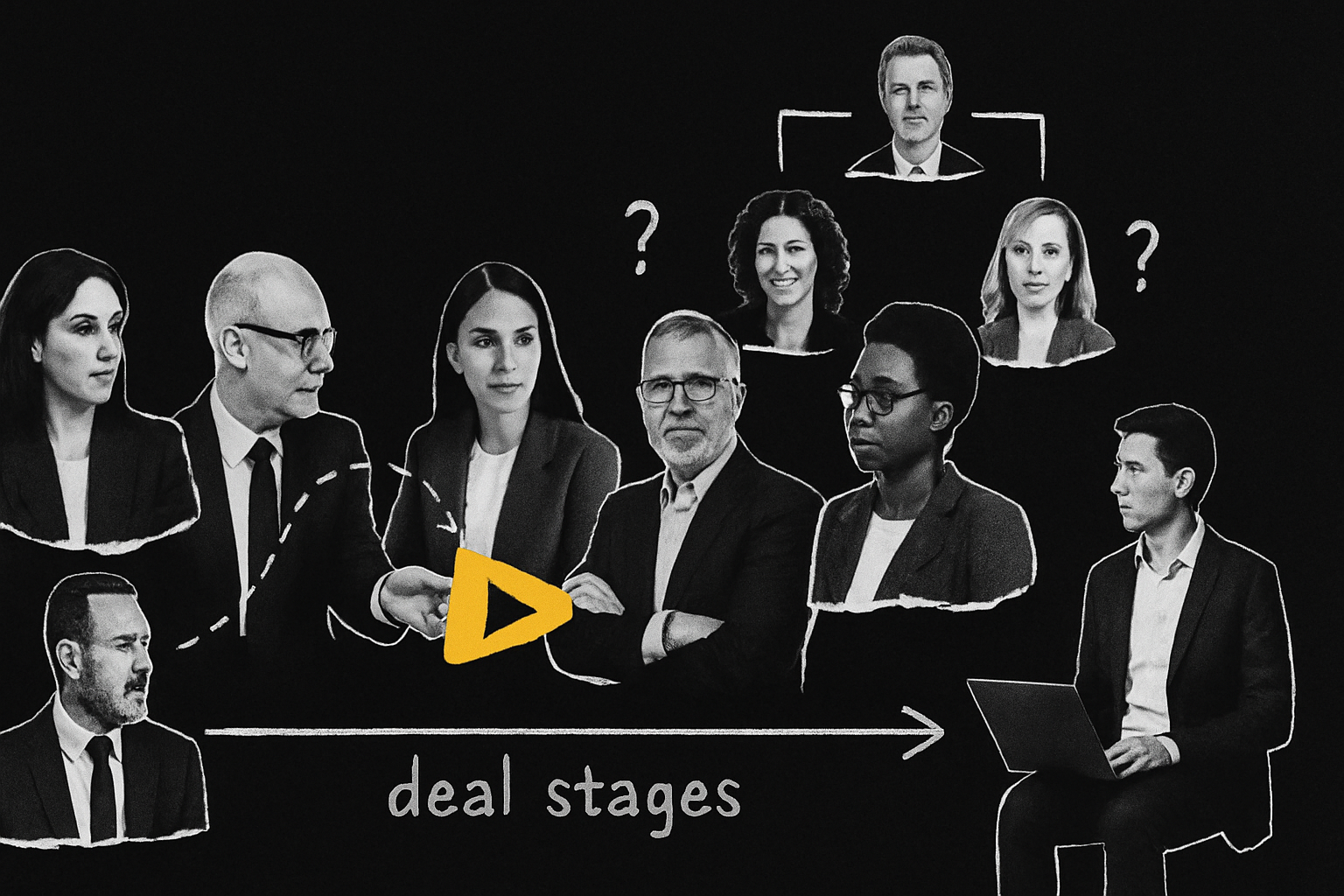
The practical arrangement is a standing input from sales and a standing output back to them. Sales supplies the objections and the target guest list. Marketing turns those into episodes. Marketing then hands back something sales can use in a live deal: episode playlists mapped to buying stages, and specific clips a rep can send with a line like “we covered exactly this last week, thought of you.” Lemonpie’s team describe using their own library this way, pointing a prospect who raised a question about ROI or attribution to a 45-minute episode on it, which the buyer then shares internally to bring the rest of their committee along. That is the podcast doing work a sales call cannot do, because it removes the pressure of the sales call.
One more reason to resist sales ownership: the show has to survive a bad quarter. When a revenue team is behind, anything without a same-quarter return gets deprioritised. A podcast has a longer payback than that, and it needs to sit somewhere that can hold a twelve-month view.
| Ownership model | Where it works | Where it breaks |
|---|---|---|
| Marketing owns production, sales owns application | Most B2B service and technology companies. Editorial quality holds, episodes get used in deals, budget has a defensible home | Requires an actual handover ritual. Without one, sales never touches it and the show becomes marketing’s private project |
| Sales or business development owns the show | Guest-as-prospect programmes where the invitation itself is the outreach and the target list is the point | Content quality drifts towards pitching, and the show stops earning the listen it needs to work at all |
| Founder or CEO owns it personally | Small firms where the founder is the brand and there is no marketing function to own anything | The least protected calendar in the business is now the show’s dependency |
| Shared ownership across marketing, sales and product | Nowhere. Shared accountability for a publishing cadence is no accountability | Everyone assumes someone else booked the guest |
Who exactly should hold it inside marketing?
Name a person, not a team. The owner is whoever is accountable for an episode going live on the date it was promised, and that person needs three things: enough seniority to get a guest’s diary and an executive’s diary in the same week, enough editorial judgement to kill a weak episode idea, and enough of their week actually free to do it.
In practice this lands with a content lead, a brand or communications lead, or a demand gen manager who also runs the content engine. Titles matter less than the person’s ability to say no. An owner who cannot decline a request from sales to interview a customer who has nothing interesting to say will produce a show that nobody finishes.
Then separate two roles that companies routinely collapse into one, and pay for it later.
The owner runs the programme: cadence, guest pipeline, briefing, publishing, repurposing, reporting. The host sits in the chair and does the interview. These can be the same person, and often are at smaller companies, but they are different jobs with different requirements. The host needs domain depth and the willingness to disagree with a guest on tape. The owner needs project discipline. If your best interviewer is a subject matter expert with no interest in chasing guest availability, do not make them the owner. You will lose both roles at once.
The executive sponsor is the third seat, and the one most often left empty. Company politics kill more branded podcasts than bad audio does. The fix is to put executives in the show deliberately: as occasional guests answering the objections buyers actually raise, and by having leaders quote the show in internal and external communication. Nairn describes a financial brand where the CIO became a recurring guest, and his credibility gave the show weight outside the company and political protection inside it. Leadership stopped questioning the budget because their fingerprints were on it. Sponsorship is a real job with a low time cost, and it is the difference between a show that renews and one that gets cut in a planning cycle.
How much of one person’s time does a podcast need?
More than the recording, which is the part everyone budgets for and roughly a third of the work.
Rather than guess at hours, list the work and decide for each line whether it sits with your owner, another internal person, or a production partner. A fortnightly interview show involves guest sourcing and outreach, scheduling and rescheduling, pre-call briefing, the recording itself, editing and audio cleanup, show notes and episode pages, clip selection and cutting, publishing to the feed and the website, promotion across LinkedIn and email, and whatever reporting your leadership needs. Only two of those, the briefing and the recording, genuinely require the host.
Two patterns tell you whether you have under-resourced the role. First, an internal volunteer says yes with enthusiasm, then discovers that recording is a fraction of the commitment and quietly backs out. Second, someone gets pulled onto a product launch or a rebrand and disappears for four months, taking the show with them. Both are common enough to plan for rather than be surprised by.
The realistic options, in order of how much internal time they consume: run everything in-house and accept that your owner has a part-time second job; keep hosting, guest relationships and editorial direction internal and outsource production, editing and repurposing; or bring in a partner who also handles guest booking and strategy so the internal commitment collapses to the interviews and sign-off. B2B Better exists as a B2B podcast agency because the second and third options are where most marketing teams should sit, and because production capacity is the constraint that quietly determines whether a show reaches episode fifty.
What moves the cost of external support is straightforward: episode volume, whether you are producing video as well as audio, how much distribution and repurposing is included, and whether strategy and guest booking sit in scope or with you. Get quotes against a defined episode count and a defined deliverable list, or you are comparing numbers that describe different jobs.
What happens when the owner leaves?
Assume they will. People leave companies, and a show built entirely around one person means their resignation is also the show’s. The usual outcome is a long pause and an attempt to restart months later, which is harder than launching, because you are relaunching something the audience already watched go quiet.
Four things make a show survivable, and none of them take long to put in place.
- Two hosts rather than one, rotating episodes. It halves the per-person load and gives you built-in cover, which is often the difference between publishing at month eighteen and fading at episode eight.
- A written operating document: format, episode length, pillars, guest criteria, briefing template, the publishing checklist, the tooling and who holds the logins. If the process lives in one person’s head, it leaves with them.
- Feed and account ownership under company credentials, never a personal email address.
- A guest pipeline three to four episodes deep at all times, so a handover happens against booked recordings rather than an empty calendar.
There is a version of this problem specific to founder-hosted shows. The case for a CEO host is genuinely strong, because they are not going to leave and they carry authority with a buyer. The failure is predictable: a fundraise, a board deadline or a new baby arrives, and interviews start getting cancelled. Content Allies documented exactly that, a founder who would not let anyone else host, then a fundraise and a new child, and the show stopped looking healthy.
The fix is a split. One producer’s published example has a main host handling around 75% of interviews and the founder taking the remaining 20-25%, stepping in for guests he specifically wants to talk to. The founder’s authority is attached to the show, the bandwidth sits with someone whose job it can be, and a six-week absence does not stop publishing.
If your CEO wants the chair to themselves, make the trade explicit. Ask them to block recording slots for the next six months, in the calendar, before episode one. The ones who do it are fine. The ones who will not have answered the question.
What should the owner be measured on?
Not downloads. Downloads are a health check on distribution, and they are a poor argument in a budget meeting. For context on what normal looks like, Lemonpie put the average podcast at around 175 downloads per episode, and reaching 500 per episode inside your first year as doing well. That framing is useful precisely because it stops a marketing leader promising numbers that would make the show look like a failure at episode ten.
Hold the owner to measures a commercial audience recognises: whether episodes are cited in deals or an RFP, whether sales cycles where the buyer engaged with the show run shorter, how many target accounts entered a conversation through a guest invitation, and how much of your wider content output now derives from episodes. Tie it back through your CRM with UTMs, tracked links and a question in discovery about where the buyer first heard of you.
Something worth stealing: Allianz Trade used their show internally to onboard new hires. An asset that trains your own people and warms your buyers is much harder to cut.
One last structural point. Set the internal owner’s remit for at least twelve months, in writing, and count the episodes you have committed to. A show reviewed quarterly against download targets will be cancelled before it has done the work it was built to do.