A podcast is the wrong channel when you need volume at the top of the funnel, when nobody senior will commit to hosting for at least 12 months, when your buyers are not audio or video consumers, or when your pipeline problem sits at conversion rather than trust. Podcast discovery is weak by design. If your problem is reach, a podcast will not fix it.
That is the short answer. The longer answer matters because the failure mode is expensive and slow. A podcast that is wrong for you does not fail in week two. It fails at episode 40, after 18 months of budget, when someone in finance asks what it returned and nobody has an answer.
When should a B2B company not start a podcast?
Six situations where the honest recommendation is don’t.
1. You need top-of-funnel volume this quarter. Podcast discoverability is genuinely poor. Apple Podcasts and Spotify have no equivalent of YouTube’s recommendation engine surfacing your show to people who have never heard of you. Growth comes almost entirely from channels you already have: LinkedIn, email, guest appearances, word of mouth, paid. So a podcast will not bring large volumes of new people into your orbit. Its value is depth, in the middle and bottom of the funnel, converting interested prospects into people who trust you. If your board wants MQL volume by end of quarter, a podcast is the wrong instrument.
2. No one credible will host it. The format is intimate. Listeners spend 27-31 minutes of a 45-minute episode with one voice, and completion rates for podcast episodes run 60-70%, higher than any other B2B content format. That depth only works if the person talking has a real point of view and enough standing in the market to hold a conversation with a senior guest. If the show is handed to whoever has capacity, you get what one practitioner in this space calls content wallpaper: polite, vague, interchangeable. Technically fine. Sells nothing.
3. The commercial fundamentals aren’t in place. Before a podcast is worth funding, you want product-market fit you are confident in, a website that converts, a sales team with a decent close rate, low churn and more than 12 months of runway. Podcasting requires a tolerance for channels traditional attribution cannot fully track. If your organisation has never successfully invested in something it cannot measure to two decimal places, the show will be killed before it compounds, and you will have wasted the spend either way.
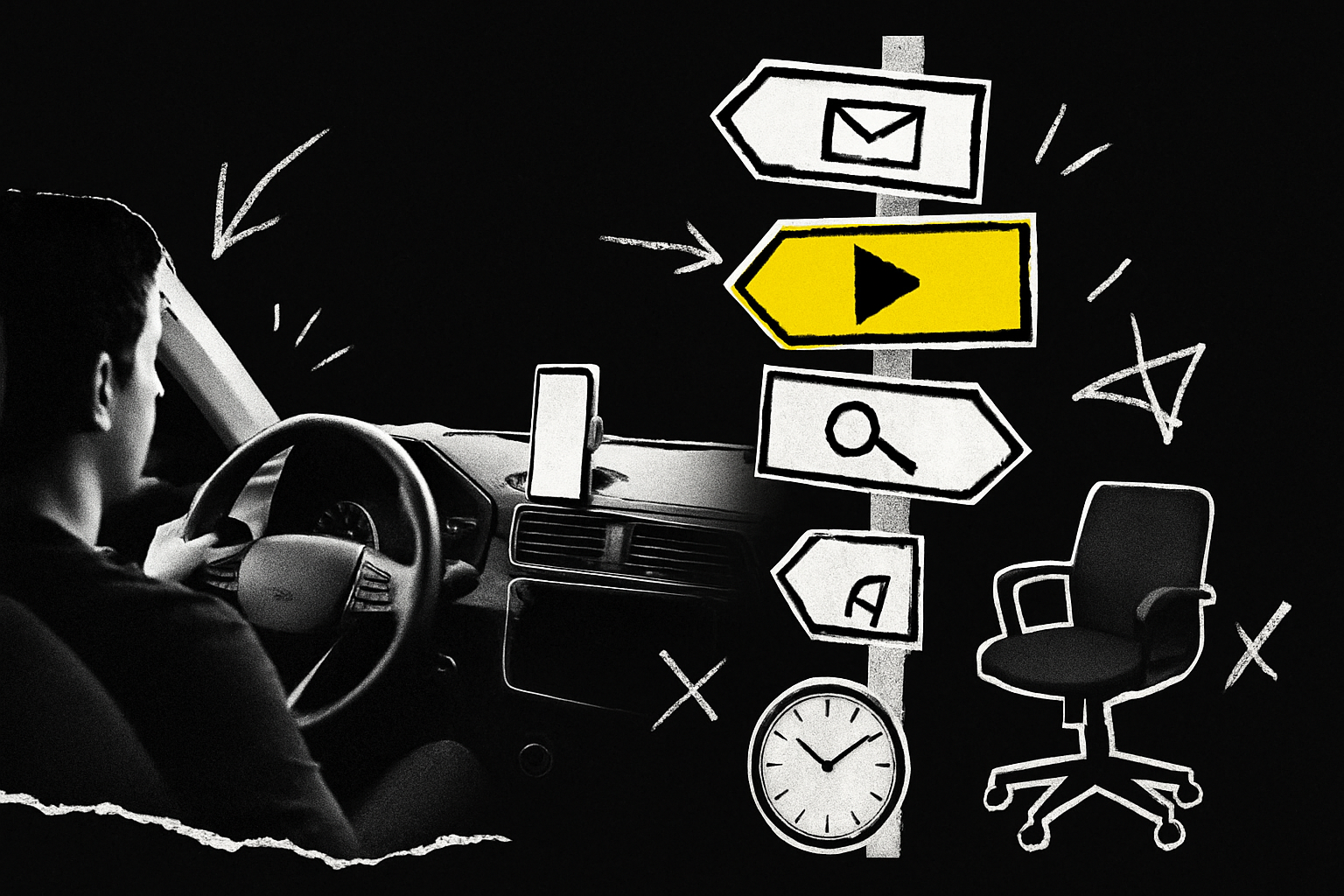
4. Your buyers are not there. This sounds obvious and it is the most common expensive mistake. Work out who you are trying to reach and where they actually spend attention before you choose the channel, not after. A consultant selling to executives who drive between meetings with Apple CarPlay on is in a very different position from someone selling to a buyer who never listens to anything. The second buyer does not become a listener because you launched a show.
5. Your problem is conversion, not trust. If prospects reach your site, understand the category, get to a demo and then stall on price, packaging or proof, a podcast does not touch that. Case studies, pricing clarity, sales enablement and product marketing do. Podcasts work upstream of the objection, by making buyers arrive already convinced. They do not rescue a broken close.
6. You cannot sustain a cadence for a year. A biweekly rhythm, one episode every two weeks, is roughly the minimum viable commitment for building an audience and a searchable archive. Weekly is ambitious, monthly loses momentum. Of more than 4.5 million podcast shows registered globally, only around 342,000 have published in the past 90 days. Shows rarely die from lack of ideas. They die from lack of infrastructure and stamina.
What has to be true before a podcast works?
Treat these as gates. If you cannot pass one, either fix it or pick a different channel.
| Gate | What good looks like | What it means if you fail it |
|---|---|---|
| Editorial identity | You can state who the show is for and what it is about in one sentence your sales team can repeat back | A vague concept produces a vague show that will not survive ten episodes |
| A named job | The show has a defined role in a specific business outcome, not “brand awareness” | Without a job, the show drifts into the noise your other channels generate |
| A host with standing | Someone senior, with a point of view, committed to recording for 12 months | You produce polite, interchangeable content nobody remembers |
| Buyer presence | Evidence your ICP actually consumes audio or video in their working week | You are shouting in a room your buyers never enter |
| Distribution you already own | A LinkedIn following, an email list, a sales team who will send episodes | Zero discovery, zero audience, and a back catalogue nobody hears |
| Measurement everyone agrees on | Signals other than downloads, agreed with finance before launch | The show gets cancelled in month 14 by a spreadsheet |
| Repurposing capacity | Someone owns clips, show notes, transcript and newsletter, week in week out | You capture a fraction of the value and the economics never work |
The gate people skip is the second one. A podcast can be technically excellent and commercially pointless at the same time. Downloads are a pulse, not a business metric. The question that actually matters is whether one person who could genuinely buy from you moved closer to buying because of an episode. Decide how you will know that before you record.
Two other useful tests. First, could your podcast ever be proven a failure? If the stated goal is unfalsifiable, it is a horoscope, not an objective. Second, can you name one real buyer, a person, not a persona, who would want to listen? If you cannot, the concept is not ready.
Is your pipeline problem actually a channel problem?
Often the diagnosis is wrong in the other direction. The podcast is the right channel and everything around it is the waste.
One agency in this space describes a client, name changed, who spent £20,000 on her podcast and got £6,000 back. Her financial adviser flagged the gap and she came within weeks of shutting the show down. The problem was not the show. She had hired specialists across SEO, email, website, YouTube, social, Pinterest, Facebook and Instagram Reels, each one excellent at their channel, each genuinely convinced their channel was the answer, and most of them optimising places her buyers never went. Ten people making the wrong channels as good as they could possibly be. Her buyers were senior consultancy clients: in cars listening to podcasts, on YouTube at home, answering email. Not building Pinterest boards. The recommendation was to cut from seven channels to four and give the podcast an actual job, rather than kill it.
Specialists are not scamming anyone. They are incentivised to believe their thing is your thing, and that incentive is invisible from inside the relationship. Which is why the sequence matters: who are we reaching, where are they, which channels are they genuinely on, and only then who do we hire. Build the map before you hire the crew. Most teams build the machinery before they have plotted the journey.
So run the diagnosis honestly. If your podcast is underperforming, check whether the show is broken or whether it is starved, sitting in the middle of six other channels that are consuming the budget and the attention it needed.
What should we do instead of a podcast?
If a branded show fails your gates, these are the alternatives, mapped to the problem you actually have.
If you need reach and discovery: YouTube. YouTube’s search and recommendation engine puts content in front of people who have never heard of you. B2B buyers search for comparisons, evaluations and how-to content, and long-tail queries face less competition on YouTube than on Google. Video results also surface in Google. The trade-off is effort: a scripted YouTube video runs 3-5 hours of pre-production, 1-3 hours recording, 5-10 hours editing, plus thumbnail and SEO work, roughly 10-20 hours per video. Average completion on long-form video sits at 30-40%, below podcast completion, but the visual format shows things audio cannot: demos, screen shares, expressions.
If you want a pre-built audience without building your own: a podcast tour. Guesting on other people’s shows removes the two hardest parts, audience building and consistency. There are likely 20-200 or more shows in a given category reaching your buyers. Rand Fishkin of SparkToro has said that out of 170 paying customers, the majority reported hearing about the company through his podcast appearances, off the back of guesting 2-3 times a week. Huckabuy took domain authority from 10 to 45 over a podcast tour, with organic traffic going from under 500 to 30,000-plus monthly visitors. The catches: it needs genuine domain expertise, outreach is manual and hard to scale, and you never own the audience. A useful qualifier is the top 50% rule. If you would be as good as or better than half the interviews already on a given show, you will be a successful guest.
If you want reach on a specific show’s audience without producing anything: podcast ads and sponsorships. Buying placement on existing shows targets an audience someone else built. It is a media buy, with media buy economics and none of the relationship benefits of hosting.
If your problem is that nobody knows the category exists: SEO and content. Search remains the most common way people find information. Organic search tends to serve upper-funnel education, paid search targets commercial-intent terms and works faster and more predictably than organic. If your issue is that buyers do not know your solution type exists, that is a search and content problem.
If your problem is that buyers know you but don’t trust you enough to buy: events. Events reach smaller audiences than almost anything else and offer direct engagement in return, especially interactive formats like roundtables and webinars. For a small, named account list, a roundtable programme often beats a podcast on speed to relationship.
If your problem is depth with a named account list: an account-based version of the same idea. Interviewing your target buyers, rather than broadcasting at a market, gets you the relationship value without needing an audience at all. Guest invitations get a 5-10 times higher response rate than cold sales emails, because you are offering a platform rather than asking for time. Some teams track guest status in the CRM as a relationship pipeline: identified, approved, recorded, published, followed up. If that is the value you want, you can have it with a show that never chases scale.
How do you decide in one sitting?
Work through it in this order.
Step one: name the pipeline problem in one sentence. Not enough people know us. Enough know us but they do not trust us. They trust us but they do not buy. Each points at a different channel. Only the middle one points at a podcast.
Step two: check where your buyers actually spend attention. Ask ten customers directly. Not “do you like podcasts” but what they listened to or watched in the last fortnight. If audio and long-form video are absent from those answers, stop here.
Step three: find the host. Name the person, get their diary commitment in writing, for 12 months. No host, no show. This kills more good podcast plans than budget does, and it is better to kill it now.
Step four: write the sentence. One line that says who the show is for, what it changes for them and what job it does for the business. If your sales team cannot repeat it back, it is not ready. Cadence, length, video or audio, guest strategy: all of those are construction details, and construction details are only right or wrong relative to a plan.
Step five: agree the scoreboard with finance before you launch. Include the signals that actually indicate progress: prospects mentioning the show on discovery calls, guests who convert (one estimate puts guest-to-customer conversion at 15-25% over 12 months), email engagement on episode sends, replies to the newsletter version, and how much usable content each recording produces. Get sign-off that these count. Otherwise you are building something that will be judged by a metric you already agreed was misleading.
Step six: decide what you are cutting to fund it. A podcast added on top of an already-full channel mix gets starved. Something else has to go.
What does it cost to get this wrong?
The cost is not the production fee. It is 12 to 18 months of a senior person’s calendar, the opportunity cost of the channel you did not build, and the internal credibility hit when the show is quietly shelved. From the inside, a podcast doing nothing for your business and one converting well look almost identical: same download graph, same “great episode” comments, same warm feeling afterwards. That is what makes this failure mode so expensive. It does not announce itself.
There is a version of this that goes the other way, though. Around 62% of B2B buyers listen to podcasts for professional purposes, and the supply of active shows is thinner than the registration numbers suggest. Buyers who binge a back catalogue arrive at a sales conversation already understanding your position, which shortens the cycle. Guests become customers and referrers. One 45-minute recording produces an episode, a YouTube video, three to five clips, a transcript, show notes, a newsletter feature and weeks of social. Transcripts and structured show notes also give AI tools something citable, which is increasingly how buyers find answers.
None of that happens by accident. It happens when the show has a job, a host and a scoreboard. As a B2B podcast agency, the most useful work we do is often the conversation that ends with a client not launching a show, or cutting three channels so the show they already have can finally do something. If your answers to the gates above are honest and the podcast still passes, build it properly. If it does not pass, pick the channel that matches the problem you actually have, and revisit audio when your commercial fundamentals and your host are both ready.
What should you ask before signing with a production partner?
If you have cleared the gates and you are buying help, these questions separate strategy from studio time.
Ask what job they think the show should do, before they ask you about format. Ask how they would know if the show failed. Ask what happens to each episode after it publishes, specifically who writes the show notes, who cuts the clips, who edits the transcript. Ask whether guest booking and strategy sit inside the scope or outside it, because that single line moves the price more than anything else. Ask how the show connects to your CRM, and whether guest status is tracked as a pipeline. Ask what they would cut from your current mix to fund it.
The cost drivers are predictable: how many episodes a month, whether you are producing video as well as audio, how much distribution and repurposing is included, whether strategy and guest sourcing are in scope, and how much of your own team’s time you can put in. A partner who cannot explain which of those levers is moving your quote is selling editing, not outcomes.