A video podcast programme includes show strategy and positioning, guest sourcing and booking, recording (in person or remote), multi-camera or single-camera edit, an audio cut for the podcast feeds, a set of short clips per episode, thumbnails and titling, publishing across YouTube and the audio platforms, and reporting that ties back to pipeline. Everything else is variation on that spine.
That list is easy to write and hard to run. The reason companies buy a programme rather than a producer is that the ten items above sit in three different teams internally and nobody owns the handover between them.
What is included in a video podcast programme, in order?
Think of it as a chain where each link creates the input for the next one.
Strategy comes first: who the show is for, what question it answers that nothing else in your category answers, the format (solo, interview, panel), episode length, and cadence. Get this wrong and every downstream cost is wasted, because you will produce technically clean episodes nobody in your buying committee needs.
Guest sourcing follows, and for B2B it is the part most often underestimated. If the guest list is your ICP, the show doubles as an account-based programme before a single episode publishes. If the guest list is whoever said yes, you have a hobby.
Then production. Recording happens in a room you control or over a platform that records each participant locally, so a wobbling connection does not degrade the master files. Riverside works this way; Zencastr and Zoom are the other names buyers usually run into, and OBS covers solo or multi-angle setups where you want more control over what gets captured. Editing splits into the long-form video cut, the audio-only cut for Apple and Spotify, and the shorts.
Packaging is the part in-house teams skip. Every episode needs a 16:9 thumbnail of its own, a title that a human would click and a search engine can parse, chapters with timestamps, and a description written like a short blog post. YouTube’s own guidance is direct on this: chapters are non-negotiable for anything over 20 minutes, and chapter titles get indexed by both YouTube and Google, so a single long episode can rank for dozens of different search terms.
Distribution puts the long-form video on YouTube, the audio on the podcast apps, the video on Spotify where listeners can watch or listen without switching platforms, and the clips wherever your buyers actually scroll. Apple supports video too.
Measurement closes the loop. Watch time, audience retention and click-through rate tell you whether the episode worked as content. Guest-to-opportunity conversion, pipeline influenced and sales team usage tell you whether the programme worked as a business investment. A programme that reports only the first set is reporting on the wrong thing.
Do we need a studio to make a video podcast?
No. You need a controlled room, which is a different requirement and a much cheaper one.
The room matters more than the camera. Hard floors, bare walls and large windows create the echo that makes a good microphone sound cheap, and rugs, curtains, bookshelves and acoustic panels fix most of it. The clap test is a genuinely useful thirty-second diagnostic: clap loudly in a candidate room and listen to how long the sound rings out. Less ring, better room.
On gear, the honest spectrum runs from static image to fully produced. YouTube describes three levels: audio paired with static cover art (sometimes with a waveform visualiser), a single camera shot of the host, and a fully produced show with multiple angles, B-roll and on-screen graphics. The middle option is where a lot of B2B shows should start, because turning a camera on adds the human element that drives connection, and it costs you a webcam and a lamp.
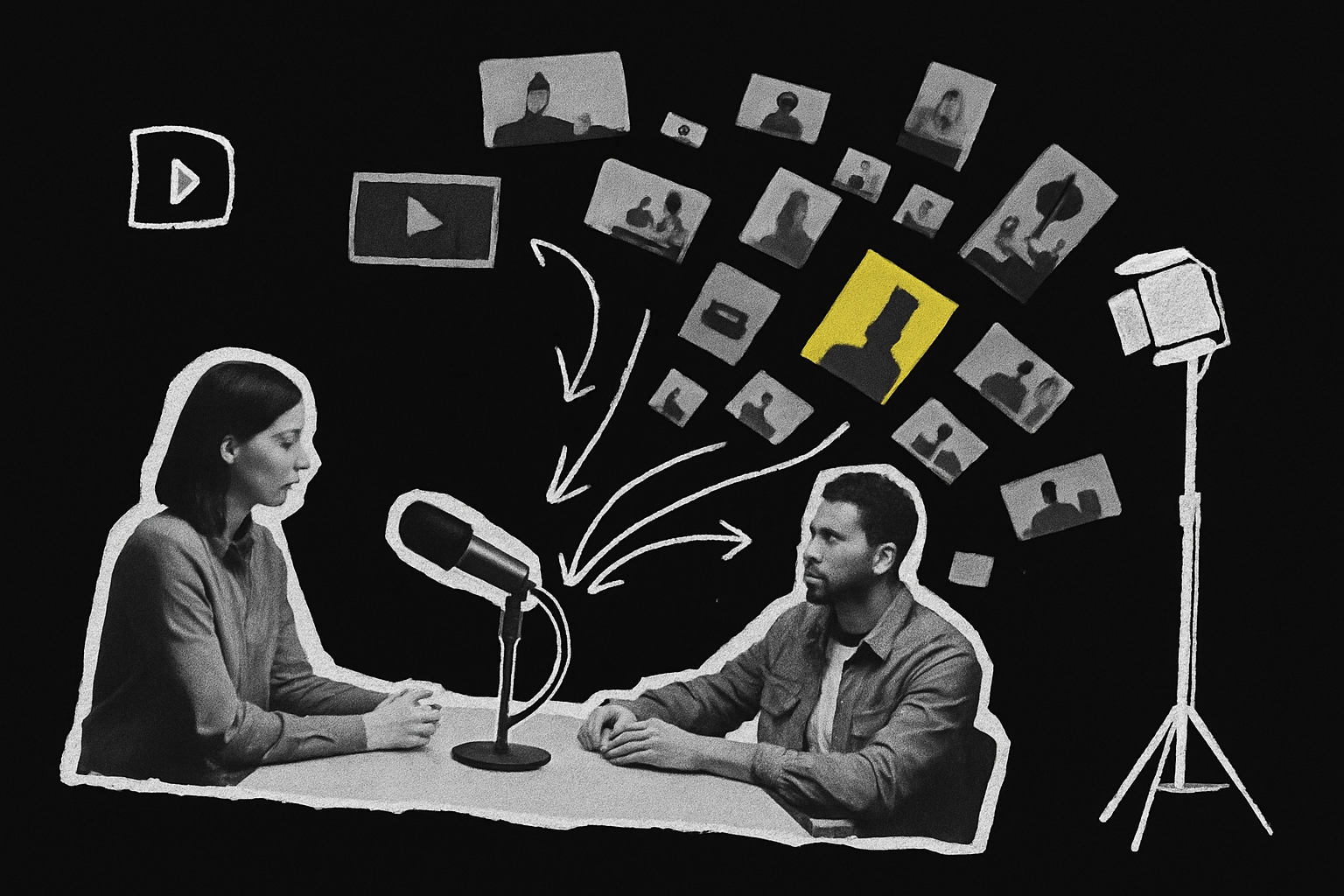
If you do build out, the two-person setup that most production teams use is a wide shot showing both people plus a camera shooting diagonally at each person, so the edit can cut cleanly between speakers. Buy the same brand of camera for every angle. Different manufacturers process colour differently and matching a Sony to a Canon in post is a slow, avoidable job. Three lights will cover two people if you cross-key them: key lights diagonally behind each subject, which doubles as a hair light on the person opposite, plus a single fill behind the main tripod with a softbox or lantern modifier.
Audio takes priority over video every time. People will watch a mediocre-looking video with clean sound and will abandon a beautiful one with muffled sound. A USB microphone plugged straight into a laptop clears the bar for most B2B shows; XLR with an interface is the upgrade, not the entry point. Keep the mic off to the side or below the mouth rather than directly in front of it, which handles plosives without a pop filter in shot.
Where a hired studio does earn its keep: when your guests are senior enough that you cannot ask them to fix their own lighting, when you record several episodes in a single day to bank a quarter’s content, and when the show is customer-facing enough that production values are read as a signal about the company.
| Setup level | What it takes | Best for |
|---|---|---|
| Static visual | Audio file plus cover art, optional waveform | Getting an existing audio show onto YouTube with no new workflow |
| Single camera | Webcam or phone on a tripod, one light, USB mic, treated room | Solo host shows and remote interviews where speed matters more than polish |
| Multi-camera, in room | Two to three matched cameras, three-point cross-key lighting, XLR mics, set dressing | Flagship shows where guests are prospects and the recording is a sales moment |
| Hired studio day | Booked space and crew, several episodes recorded back to back | Banking a quarter of episodes at once, or hosting executives you cannot ask to self-set-up |
How many clips does one episode produce?
There is no fixed number, and any agency quoting one without seeing your format is quoting a production line rather than a plan. What determines it is how many genuinely standalone moments the conversation contains.
The working method is the one YouTube describes: treat the episode as a content pillar and go looking for the compelling 60-second moments inside it. A sharp anecdote, a contrarian claim, a number that stops people, a disagreement between host and guest. In a well-hosted 45-minute B2B interview you can usually find between four and eight of those. In a badly hosted one you can find zero, and no amount of editing rescues it, which is why hosting quality is a production variable and not a personality trait.
The clip count also depends on what you count. Vertical shorts for LinkedIn and YouTube Shorts are one output. Audiograms, quote cards, a written summary, a newsletter section and a sales-enablement cut you send to a specific account are all derivatives of the same recording. One session can generate weeks of surrounding content, and the practical constraint is usually the publishing calendar rather than the raw material.
A useful contract question: ask whether clips are selected by someone who understands your buyer or by an editor working from a transcript. The first produces clips that create sales conversations. The second produces clips that are technically correct and commercially inert.
What does an agency do that an in-house team cannot?
Consistency under load. In-house shows die in month four, when the demand gen lead who volunteered to host gets pulled onto a product launch and two weeks of episodes slip. The medium punishes gaps harder than it punishes mediocre episodes.
There are three specific jobs that go badly in-house. Guest booking is a sales process, and marketers who have never done outbound find it brutal; a programme with a booked pipeline of guests eight weeks out behaves completely differently from one scrambling for next Thursday. Editing to a deadline every single week is a discipline, not a task, and it is the first thing to slip when someone edits between meetings. And the repurposing layer, the clips and the descriptions and the thumbnails, is dull enough that it quietly stops happening while the episodes keep going out, at which point you are producing content nobody sees.
The counter-argument is real. If you have a video editor with spare capacity, a natural host, and a marketing team that has shipped a weekly asset for a year without missing, you do not need an agency to press record. B2B Better works with service and technology companies who want the show to generate pipeline rather than just exist, and the honest test is whether your bottleneck is capability or capacity. Buy for the one you actually have.
What drives the cost of a video podcast programme?
Nobody can quote you a number without knowing five things, and any quote that arrives before those questions have been asked is a template.
Episode volume and cadence set the base. Weekly costs more than fortnightly, and not proportionally, because the fixed strategy and setup work spreads across more output while the per-episode editing does not.
Video complexity moves the number the most. A single-camera remote recording, a multi-camera in-room shoot, and a fully produced show with B-roll and motion graphics sit at completely different levels of edit time. The step from one camera to three is not three times the cost, it is three times the footage plus the sync, the colour match and the cutting decisions.
Distribution scope is the variable buyers forget to specify. Delivery of a finished file is one thing. Publishing across YouTube and the audio platforms with per-episode thumbnails, chapters, keyword-rich descriptions and scheduled clip posts is a materially bigger job, and it is the job that determines whether anyone watches.
Strategy and guest booking in or out of scope changes the shape of the engagement entirely. Sourcing, qualifying, pitching and scheduling target-account guests is closer to an SDR function than a production one, and it is priced accordingly.
Then the smaller multipliers: whether you need a hired space, how many people are on camera, whether transcripts and written derivatives are included, and how much rights-cleared music, branding and template work happens up front.
To get a real number, ask for a quote against a specific spec: episodes per month, camera count, in-person or remote, number of clips per episode, who books guests, who publishes, and what the reporting cadence is. Then ask what happens to the price if you halve the cadence. The answer tells you how much of the fee is fixed overhead and how much is genuine per-episode work.
What should be in the contract that usually isn’t?
Four things, and their absence is what turns a working relationship sour around month five.
Ownership of the raw files, not only the finished cuts. If the relationship ends, you want the masters, because they are the raw material for everything you make afterwards.
A named turnaround from recording to publish. Without it, “we’ll get it to you” becomes three weeks, and a show that publishes irregularly loses the habit-forming quality that makes podcasts work in the first place.
A definition of a clip. Length, whether it is captioned, whether it is delivered in both vertical and square, and who writes the accompanying post. “Five clips per episode” without those details is five video files and a problem.
And a stated position on who owns discovery. Somebody has to write the titles, build the thumbnails, add the chapters and choose the keywords. If that is not written down as someone’s job it becomes nobody’s, and the show becomes a well-produced asset with no route to an audience.
What does a good programme look like after six months?
A back catalogue that a salesperson can search, so that when a deal stalls on a specific objection there is an episode where a respected practitioner answers exactly that. A guest list that reads like a target account list. A YouTube channel where individual episodes pull search traffic for the questions your buyers type, because the chapters and descriptions were written with that in mind. A clip cadence steady enough that people who have never listened to a full episode still recognise your point of view.
What it does not look like is a download chart. Downloads tell you almost nothing about whether the right forty people heard you, and in B2B the right forty is the whole game. Ask for reporting that names accounts, not just numbers.
The stakes are simple. Video podcasting has stopped being a differentiator on its own; YouTube and Spotify both prioritise it, and the volume of shows means format alone buys you nothing. What still separates a programme that returns money from one that quietly gets cancelled is whether the guest list, the questions and the distribution were designed around a buying committee, or around a content calendar.