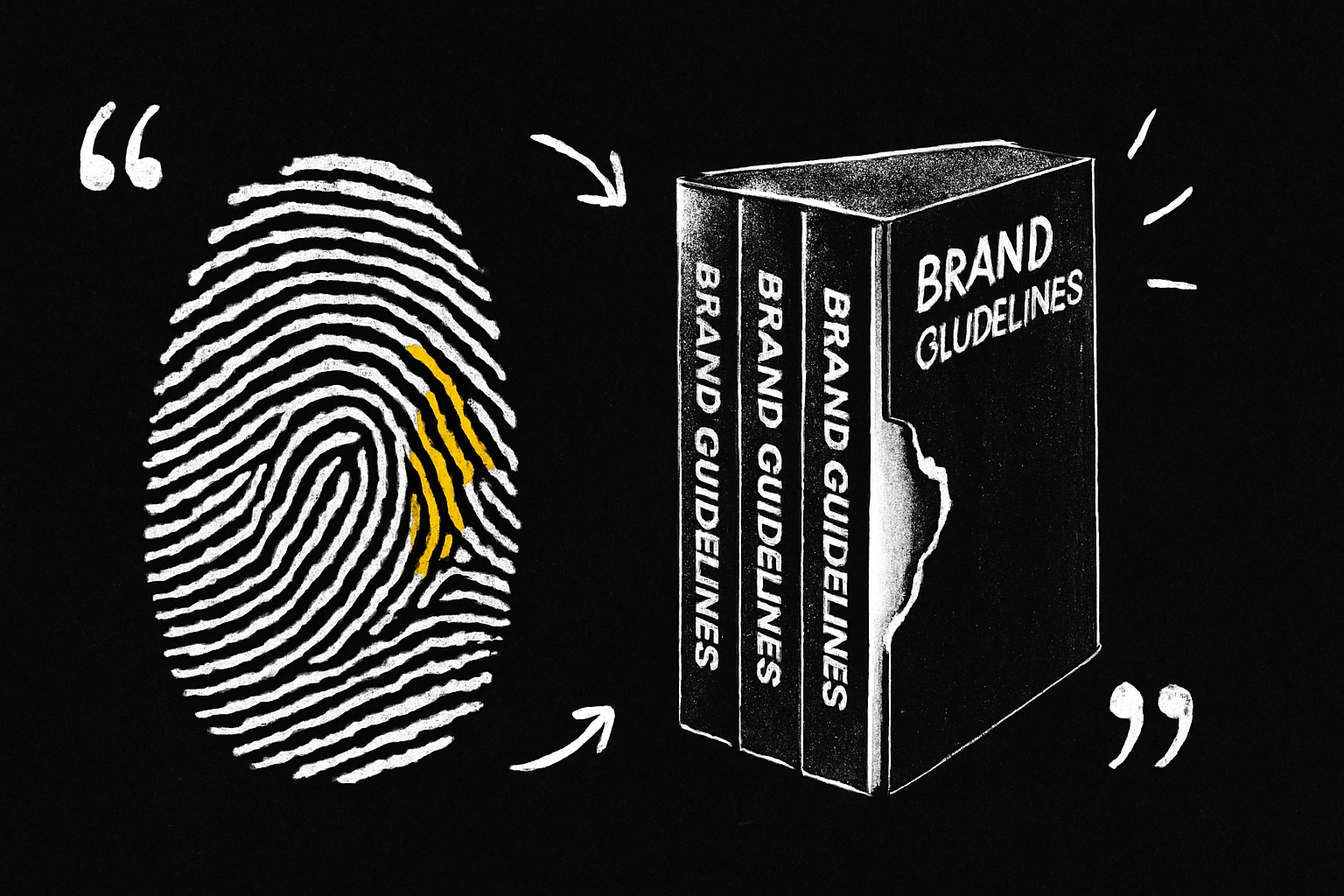
Marketing Dive’s latest piece on brand personality makes a point that sounds obvious until you check whether your own marketing actually lives it: personality isn’t decoration on top of a brand strategy. It’s the mechanism that keeps what you execute aligned with what customers expect and what marketers intend to express. When that mechanism breaks, the gap between the brand deck and the brand experience becomes visible fast.
For most B2B companies, that gap is visible every day, in every format except one. Your website copy is on-brand because legal and brand reviewed it. Your social posts are on-brand because a content calendar dictated the tone. Your one-pagers, your ads, your nurture emails: all filtered, all smoothed, all interchangeable with a competitor’s if you swapped the logo. Personality gets asserted in a brand guidelines PDF and then engineered out of everything the guidelines were meant to govern.
Podcasting is the format that can’t fake personality
A podcast is the one channel where the mechanism Marketing Dive describes gets tested in real time, unscripted, for 30 to 45 minutes at a stretch. Your CEO or Head of Product either has a point of view worth listening to or they don’t. There’s no design system to hide behind, no copywriter smoothing the phrasing after the fact. If the personality in your brand guidelines is real, it shows up in how your speaker argues a point, pushes back on a guest, or admits uncertainty. If it’s aspirational, that shows up too, as thirty minutes of safe, generic commentary that could have come from any vendor in the category.
This is why so many B2B podcasts fail quietly. They launch with the same production values, the same interview format, the same “so tell us about your journey” opening as five thousand other shows, and the personality the brand claims to have never actually gets tested. The show becomes another content asset instead of proof that the brand is what it says it is.
The audience data says the format is consolidating, not disappearing
Podtrac’s August rankings show the biggest legacy publishers losing significant ground: iHeart down 15% year on year in US monthly audience, Libsyn down 33% in audience and 50% in downloads. That’s not a signal to abandon podcasting. It’s a signal that generic, broadly-targeted audio is losing to shows with a distinct point of view and a defined audience, exactly the personality-driven differentiation Marketing Dive is describing. The listeners who remain are choosing shows deliberately, not scrolling past them in a feed. A B2B show with a real argument to make competes better in that environment than one built to be inoffensive.
The infrastructure around podcasting is also getting more sophisticated at exactly the moment personality matters most. Acast just hired Liv Sandberg, ex-TikTok and Meta, as EVP Europe, consolidating regional leadership. Red Seat Ventures has integrated contextual ad targeting at the episode level across the 40 creators it represents. This is a maturing channel investing in precision, which raises the bar for what “good” sounds like. Bland content will stand out more, not less, as the tooling around it gets sharper.
What this means for how you brief a show
Most brand guidelines describe tone in adjectives: direct, confident, curious. None of that survives contact with a scripted podcast interview format. Building a show around a genuine argument, not a topic, is the actual work: what does your CEO believe that a competitor’s CEO would disagree with? That’s the brief. It’s the same discipline we bring at B2B Better, the podcast agency behind this blog, when we scope a client’s first season, because a show with no argument to defend is a show with no personality to test.
If your brand guidelines describe a personality your content doesn’t currently demonstrate, don’t start with a rebrand. Start by putting your most opinionated executive in front of a microphone for thirty unscripted minutes and listening back honestly. That recording will tell you more about whether your brand personality is real than any workshop will.