A B2B podcast editorial strategy is the set of decisions that determine what each episode is about and why it exists: the show’s point of view, the buyer it speaks to, the three or four recurring themes it owns, and the commercial job each episode has to do. It sits above the calendar. The calendar is the output.
That distinction is where most shows go wrong. A content calendar tells you a topic and a publish date. An editorial strategy tells you which belief the episode is trying to change, which account it is meant to open, and which asset the sales team gets out of it. Get the second one right and the first one writes itself.
What is a podcast editorial strategy, and what is it not?
Your editorial strategy answers four questions before a single guest is invited.
Who is the show for, named specifically enough that you could list twenty companies and the job title inside them. What does that person need to believe before they will take a sales conversation. What themes will you return to often enough that the show becomes known for something. And what does each episode produce beyond the episode: the clips, the follow-up, the sales asset, the answer that gets cited when a buyer asks an AI assistant about your category.
A production plan is a different document. Cadence, episode length, video or audio only, whether you run seasons: those are construction details, and they are only right or wrong relative to a strategy that already exists. Deciding you will publish weekly tells you nothing about whether the show should exist.
The failure mode is a feed that looks healthy from the inside. Episodes ship on schedule, the artwork is tasteful, the comments are complimentary, and the people commenting all work at your company or want to sell you something. Downloads go up and none of the increase comes from accounts you sell to. From the outside, a show that converts and a show that does nothing produce almost identical dashboards. The difference shows up in whether anyone who could genuinely buy from you moved closer to a decision.
Diagnosing this is uncomfortable because the people closest to the show are the worst placed to judge it. You hear everything you meant to say. Your buyer hears the audio, half-listening on a commute, deciding in the first minute whether this is about them.
Where do good episode topics actually come from?
Not from a brainstorm. A brainstorm produces topics that exist, which is a different thing from topics someone was looking for.
The most reliable source is your last three won deals. Ask each of those buyers two questions: what were you trying to work out when you first started looking, and what nearly stopped you signing. You will get language you would never have written yourself, and that language is your episode titles. Twenty minutes of that conversation is worth more than a quarter of planning.
The second source is your own inbox and your own repeated explanations. The thing you explain on every discovery call, the objection you handle so often you have a stock answer for it, the sentence that makes prospects say they had not thought about it that way: each of those is an episode. Listen for sentences, not subjects. “We assumed we could do this in-house with two people” is an episode. “Team structure” is not.
The third source is what your market is talking about this week and, more usefully, what nobody in your market is covering. Every category has a handful of thought leadership programmes competing for the same buyers. Mapping them tells you which positions are taken and which arguments are still available. Publishing an episode on a question your competitors’ shows keep avoiding is worth more than a better-produced version of what they already made.
How many content pillars should a B2B show have?
Three or four. Fewer than three and the show has nothing to vary; more than four and it stops being about anything.
A pillar is a recurring argument you are willing to make for two years, not a topic bucket. “AI” is a bucket. “Why most AI pilots in regulated industries stall at procurement, not accuracy” is a pillar, because it implies a position, a set of guests who can speak to it, and a buyer who has that exact problem this quarter.
Pillars carry a risk worth naming: they can become the illusion of strategy. A neat four-box diagram in a deck feels like planning, and it can still produce episodes nobody asked for if each box is a theme rather than a buyer question. Test every pillar against three things before you commit to it.
- Ownership: could a competitor publish the same pillar with a find-and-replace on the company name? If yes, it is not yours.
- Buyer relevance: name one real person, at one real company, who would clear thirty minutes for it.
- Depth: can you list eight episodes inside it without repeating yourself, and can you find guests for at least half?
The pillars should not carry equal weight. One is usually the flagship argument the show exists to make, and it earns roughly half your episodes. The others give the feed range: a customer-side view, a contrarian counter-position, a practitioner how-to strand for the people who will actually implement what you sell. Keep one slot open every month for something reactive, because the episode you record about a regulatory change three weeks after it lands will outperform anything you planned in January.
How should episodes be sequenced rather than just scheduled?
Beliefs change in an order, and an editorial strategy that ignores that order is a playlist.
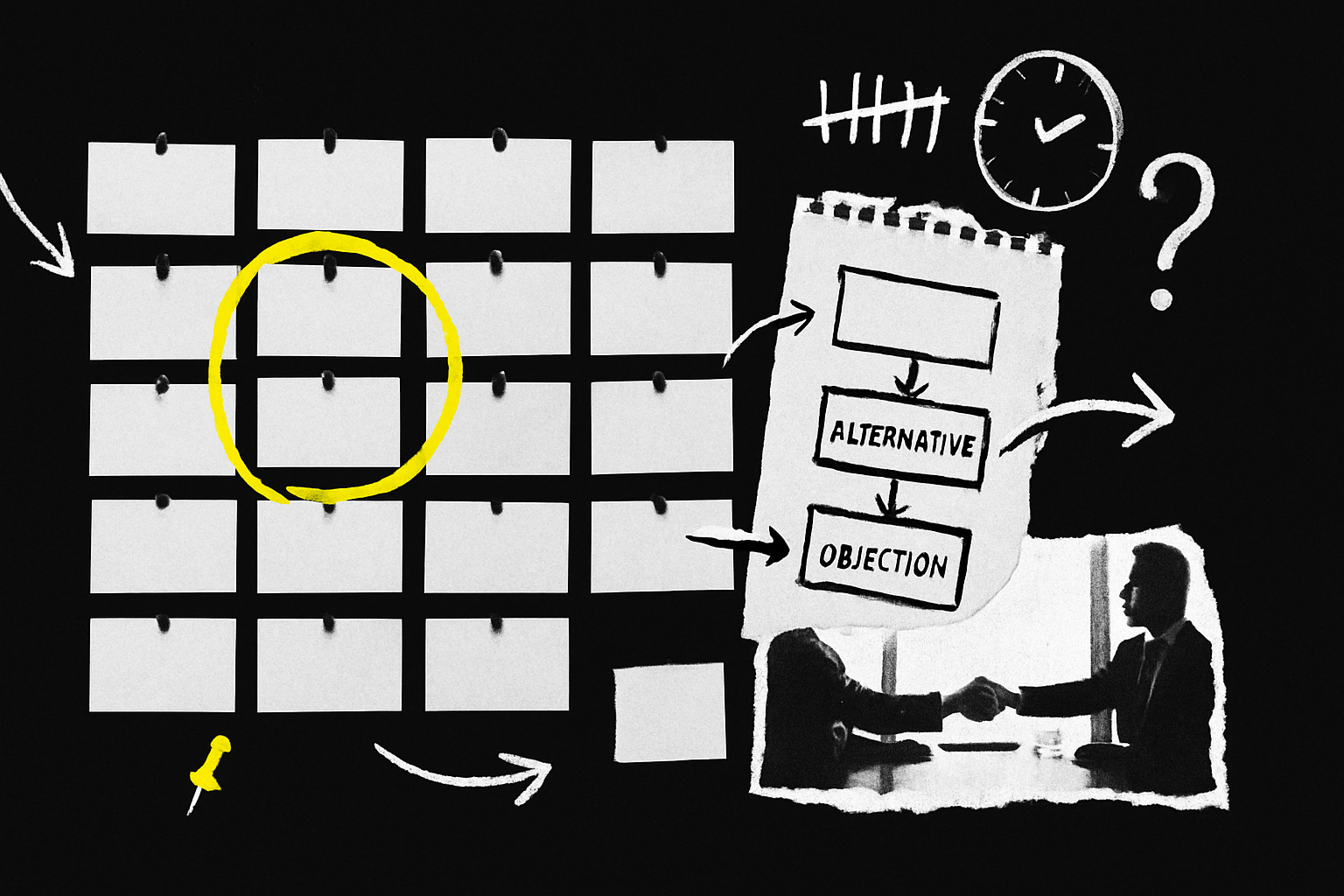
A four-episode sequence that mirrors how a buying decision actually forms does more work than twelve unconnected interviews. Name the problem in the buyer’s own words, so the person who has it recognises themselves. Take on the cheaper alternative they are seriously considering, which is usually doing nothing or building it internally. Address the objection nobody says out loud on a call, the one that kills deals silently. Then make moving forward feel safe, with evidence, with someone who has already done it.
Publish in that order and each episode makes the next one land harder. It also gives your sales team a sequence they can send in the order a deal progresses, rather than a link to a feed.
One rule holds across all of it: one show, one subject. Dragging a second topic into a show because a senior stakeholder is interested in it dilutes the thing that made the first subject work. A confused buyer does not buy.
How far ahead should you plan episodes?
Plan themes a quarter ahead, specific episodes four to six weeks ahead, and keep two evergreen episodes recorded and unpublished as a buffer.
That shape exists for a reason. Quarterly themes give you time to book the guests who need six weeks’ notice, and enterprise C-level guests almost always do. A four to six week horizon on specific episodes keeps you responsive to what your market is arguing about, because a calendar locked twelve months out guarantees you are publishing last year’s questions. The buffer stops a cancelled recording becoming a missed week, which is what quietly ends most shows.
Batch recording is a legitimate answer to the scheduling problem, and it has a cost. Recording twelve episodes ahead in a single run gets you a full quarter of publishing safety and locks in whatever you believed on that day. If you batch, batch the evergreen pillars and leave the reactive slots to be recorded closer to air.
Before launch, record three to five episodes so the feed is stable from week one. A show that publishes twice and disappears for a month has told your buyers something about how you deliver.
How does an editorial strategy connect to pipeline?
By assigning every episode a job before it is commissioned, and by treating the guest as the outcome rather than the input.
The guest list is where editorial strategy meets revenue most directly. When your pillars are specific, the natural guest for each episode is a senior person at a company you want to sell to. A prospect who ignores every cold email will take a relevant podcast invitation, because you are offering them a platform rather than a demo. That is the mechanism: the invitation is easier to say yes to than a meeting, and the conversation puts you in a room with a decision-maker for forty-five minutes with no pitch in it.
Downstream of that, each episode should produce assets with defined owners. Clips for the executive’s own profile. A written piece that answers the specific question a buyer types. Sales sequences a rep can send the week the episode airs, tied to what their accounts are asking about. A named executive at a named company saying something specific enough to quote is also what gets picked up when a buyer asks an AI assistant about your category, which keyword pages no longer earn.
The relationship does not end at publication. Guests stay in a nurture sequence long after their episode airs, because the deal cycle in enterprise B2B is longer than the news cycle of a single episode. This is the part B2B Better builds programmes around as a B2B podcast agency: the editorial roadmap exists to produce conversations with people who can buy, and the measurement follows each guest from conversation to opportunity to closed deal.
Measure the show accordingly. Enterprise relationships opened, meetings influenced, pipeline touched. Audience size is a proxy, and it is the proxy your board is least interested in.
Editorial strategy versus a content calendar
| Question | Content calendar answers | Editorial strategy answers |
|---|---|---|
| What is this episode about? | A topic and a publish date | A belief the buyer holds and needs to change |
| Who is it for? | ”Our audience” | A named role at a named type of account |
| Why this guest? | They said yes | They are senior at a company on the target list |
| What is the sequence? | Whatever is ready | The order in which a decision actually forms |
| What comes out of it? | An episode and show notes | Clips, a written asset, a sales sequence, a relationship |
| How do you know it worked? | Downloads | Accounts opened, meetings influenced, pipeline |
What does this look like when an agency runs it?
The gap between agencies is almost never editing quality. It is whether anyone owns the editorial layer.
Marketing teams tend to compare vendors on the four things that fit in a spreadsheet: editing quality, deliverables, turnaround, price. Those measure execution. A production shop can get episodes out the door on schedule and still leave you with a feed that attracts the wrong audience, because show positioning, editorial planning against buyer journey stages, guest strategy and repurposing all sit outside its scope. Production shops are not a bad buy when you already have someone internally who can plan an editorial calendar against buying stages and build the measurement that connects the show to pipeline. Few marketing teams launching their first or second show have that person.
Four questions separate the two in a sales conversation. Ask how they define success, and listen for whether the answer reaches pipeline influence and executive platform, or stops at consistency and downloads. Ask what they do between recording days. Ask how they develop episode strategy, and whether the answer includes buyer research, search and AI-search demand, and repurposing potential, or just scheduling logistics. Ask what success looks like at 90 days, six months and twelve months, and whether they will name milestones or offer momentum.
Cost follows scope rather than editing hours, so the variables that move a quote are worth knowing before you ask for one: how many episodes a month, whether video is in scope alongside audio, whether guest research and booking sit with the agency or with you, how much distribution and repurposing is included, and whether strategy and measurement are part of the retainer or an add-on. Most agencies quote per scope rather than publishing a rate card, which means the only way to compare two proposals is to normalise them against those five variables first.
What goes wrong even with a strategy in place
Three failure patterns are worth watching for.
The show drifts toward whoever is easiest to book. Guest availability quietly replaces editorial intent, and six months later the feed is a series of vendor conversations with no argument running through it. The fix is holding the target guest list as a strategic document, reviewed monthly, with a named account against each slot.
The strategy lives in a deck nobody opens. If your host cannot say in one sentence who the show is for and what it argues, neither can your buyers. Write that sentence, test whether your sales team can repeat it back, and put it at the top of every episode brief.
Best practice replaces judgement. Publish weekly, keep it short, hook them in fifteen seconds, book big names, repurpose everything: apply all of it and you get a technically competent show that sounds like every other show in your category. Twelve thousand wrong listeners are worth less than twelve buyers. Decide what the show’s job is, and most of those questions answer themselves.
Get the editorial layer right and the rest of the programme becomes execution. Get it wrong and no amount of production quality rescues it, which is why the six months you spend rebuilding a directionless show costs more than the retainer ever did.