Why the "Corporate Podcast Bubble" Article Gets It Completely Wrong
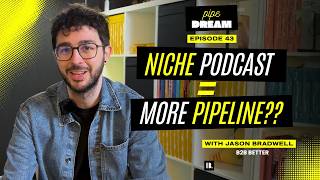
One article claimed the corporate podcast bubble is about to burst. Jason takes apart every argument, point by point.
One article claimed the corporate podcast bubble is about to burst. Jason isn’t letting that go without a fight.
A piece published on Inc.com arguing that corporate podcasting is inefficient, hard to justify, and on borrowed time landed in Jason’s feed — and rather than scroll past it, he decided to take it apart, argument by argument. In this solo episode, Jason gives credit where it’s due, challenges where the thinking falls short, and makes the case for why B2B podcasting represents a bigger commercial opportunity than ever.
The article raises four core arguments: audio is slower than text (the so-called “60% efficiency gap”), comprehension suffers in audio format, listeners lose the ability to search and skim, and ROI is nearly impossible to measure. Jason takes each one seriously and then explains precisely why the framing misses the point entirely.
The real issue is that the article evaluates podcasting as a content format competing directly with text. But that is not the right question. The person listening to your podcast is on a commute or at the gym — they are not about to open a white paper. A piece of content consumed at 150 words per minute beats one that never gets read at all.
Key Takeaways
- Why the “efficiency gap” argument misunderstands how people actually consume podcasts, and why a 150 wpm listen beats a white paper that never gets opened.
- How to evaluate B2B podcasting as a full-funnel platform rather than a content format competing with text.
- Why the comprehension study cited against audio is a category error when applied to conversational, editorial thought leadership content.
- How to use transcripts and companion content to solve the “loss of agency” problem with tools like Descript.
- How B2B organisations have attributed over £250,000 in closed-won revenue to a single podcast, tracked directly in HubSpot.
- Why the corporate podcast bubble will only burst for brands with no strategy — and what separates them from those generating real commercial returns.
Chapter Markers
- 00:00 Intro
- 01:05 The “60% Efficiency Gap” and What It Actually Means
- 02:00 The Comprehension Study: Why the Research Doesn’t Apply
- 02:45 Loss of Agency: Has the Argument Kept Pace With the Industry?
- 03:20 The Vanity Project Problem
- 04:30 Why the Article Is Asking the Wrong Question
- 05:20 How B2B Brands Are Attributing Real Pipeline to Podcasting
- 06:15 Is the Corporate Podcast Bubble About to Burst?